By Graeme Wearden • June 11, 2026 • Science
Analysts say IPO that could make Elon Musk the world’s first trillionaire has a ‘major disconnect’ on price
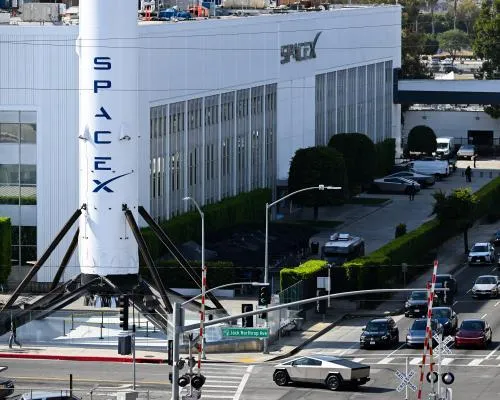
Elon Musk’s SpaceX is set to launch the biggest stock market float in history amid warnings that it may be overvalued. The space exploration, satellite broadband and AI company will join the US stock market on Friday at a valuation of $1.78tn, after offering at least $75bn of shares to investors through an initial public offering. The offering is oversubscribed by three or four times, according to Reuters, with more than $250bn of bids from investors keen to take part in the IPO. The $75bn share offer is nearly three times the previous record, Saudi Aramco’s $29.4bn offer when it floated in 2019. If the float goes as planned, Musk could make history as the world’s first trillionaire. However, the investment research group Morningstar has calculated that SpaceX is worth only $63 a share – well below the anticipated IPO price of $135 – and warns there is “a major disconnect between market expectations and underlying fundamentals”. Michael Field, the chief equity strategist at Morningstar, suggests investors should sit out the IPO and wait for “a more attractive entry point down the line”. “We believe the business has real strengths, particularly in Starlink, but with so many unknown and untested technologies underpinning much of the valuation price, particularly within the AI business, we think the valuation is extremely speculative,” Field said. SpaceX, which made a net loss of $4.9bn in 2025, is made up of three businesses: space exploration, including its Falcon and Starship rockets; connectivity, such as its Starlink satellite constellation providing high-speed internet access; and artificial intelligence, though its xAI division. At $1.78tn, the IPO values SpaceX at roughly 92 times its trailing sales, a very hefty valuation which means investors are wagering that Musk can achieve his ambitious goals for the company – such as orbital datacentres in space, building a base on the moon and cities on other planets, and to “extend the light of consciousness to the stars”. SpaceX has claimed that Starlink has a total addressable market of $1.6tn; Morningstar estimates the segment’s realistic global opportunity at about $129bn. Earlier this week, the US senator Elizabeth Warren called for the Securities and Exchange Commission to delay SpaceX’s IPO, owing to concerns about the company’s valuation and corporate governance. “Given the unprecedented threats to investor protection and market integrity posed by the biggest IPO in history, you must delay any eventual acceleration of the registration statement’s effectiveness accordingly,” Warren wrote to the market regulator on Tuesday. Investors who do not take part in the IPO may still find themselves with a stake in SpaceX, once the company is added to stock market indices. Earlier this week the index provider MSCI confirmed it would apply existing rules for early inclusion of large IPOs in its Global Standard Indexes, which probably clears the way for SpaceX to join. That would create demand from passively managed investment funds which track those indices. The Nasdaq index has made changes that will make it easier for new listings such as SpaceX to join its indices. However, S&P Dow Jones Indices has declined to relax its strict entry rules, blocking fast-track inclusion, which means it could take months before SpaceX is added to the tech-heavy S&P 500 stock index.
Source: The Guardian

Science Daily
33 posts
-
 Scientists reveal surprising mechanism behind Venus flytrap’s rapid snap
Intricate tests show hair-trigger detection causes cells on outer surface of leaf to soften, prompting closure
-
 Wegovy weight-loss pills to be available for patients in UK to buy
Regulator approval means patients who meet criteria will be able to purchase tablets with private prescription
-
 UK’s stem cell transplant system may be putting lives at risk, report by MPs finds
System not fit for purpose due to poor infrastructure and planning, with minority groups particularly at risk, MPs say
-
 Humans prefer to walk anticlockwise, scientists find – but reason is unclear
From Spain to Japan, experiments have repeatedly shown a left-turn bias, but exact mechanic ‘is still an open question’
-
 ‘Earth’s first starfleet’: Nasa reveals Artemis III crew and project’s next steps
Luca Parmitano to pilot all-male crew of four paving way for planned first human landing on Artemis IV in 2028
-
 Challenges of treating and living with a brain injury
Letters: Readers respond to an article by Ian Sample on how early intensive rehabilitation after a stroke or head injury is crucial for recovery
-
 Letter: Dame Bridget Ogilvie obituary
Mary Rice writes: Bridget Ogilvie had a wicked sense of humour
-
 Did you solve it? Do you have a snout for numbers?
The answer to today’s puzzle
-
 Muscle growth drug ‘could reduce loss of lean tissue’ when using slimming jabs
Trial suggests monoclonal antibody can help retain lean body mass when losing weight with GLP-1 medicines
-
 Can you solve it? Do you have a snout for numbers?
This game is end to end!


