What Is a Travel Technology Platform? A Complete Guide for Travel Businesses in 2026

Introduction: The Backbone of Every Successful Travel Business
Imagine booking a flight in under 60 seconds, comparing hotel prices across 500 suppliers in real time, and receiving an instant payment confirmation — all from a single interface. That seamless experience does not happen by accident. It is the result of a powerful, well-engineered travel technology platform working silently behind the scenes.
In today's hyper-connected world, travel businesses that rely on spreadsheets, manual processes, and disconnected tools are bleeding time, money, and customers. Meanwhile, companies that have invested in the right travel tech platform are scaling faster, operating leaner, and delivering experiences that keep travelers coming back.
This guide is a complete breakdown of what a travel technology platform actually is, what it does, how its modules work together, and why choosing the right development partner can make or break your travel business. Whether you run an online travel agency, a destination management company, a tour operator, or a travel startup, this article is written specifically for you.
What Is a Travel Technology Platform?
A travel technology platform is an integrated digital system designed to help travel businesses manage the entire lifecycle of a travel booking — from search and inventory aggregation, all the way through booking, payment processing, supplier management, and post-booking customer service.
Think of it as the central nervous system of your travel business. It connects to suppliers, processes data, handles transactions, and delivers information to customers and agents in real time.
Unlike off-the-shelf booking widgets or basic CRM tools, a travel technology platform is purpose-built for the complexity of the travel industry. It needs to handle real-time pricing, fluctuating inventory, multi-currency payments, supplier APIs, GDS connections, and personalised user experiences — often simultaneously, at scale.
The term "travel tech platform" covers a wide range of systems depending on the business model:
- B2C (Business-to-Consumer) platforms that power OTA websites where end travelers search and book directly.
- B2B (Business-to-Business) platforms that allow travel agents to search inventory and book on behalf of clients.
- B2B2C platforms that serve both agents and end consumers from a single unified backend.
- Corporate travel platforms that manage employee travel policies, approvals, expense tracking, and reporting.
- DMC (Destination Management Company) platforms that handle local services, activities, transfers, and ground arrangements.
What all of these have in common is a shared technological foundation: a scalable architecture, API integrations, a booking engine, an inventory management layer, and a payment system.
Why Travel Businesses Can No Longer Afford to Ignore Technology
The global travel industry is not just large — it is one of the most data-intensive, time-sensitive, and competitive industries in the world. Consider these realities:
Travel prices change by the second. Inventory across airlines, hotels, and car rental companies is shared across thousands of agencies simultaneously. Travelers today compare prices across multiple platforms in minutes. A slow search, a payment failure, or an outdated price can cost you a booking instantly.
Without a proper travel technology solution, businesses face several critical problems:
Operational inefficiency is the first casualty. Manual booking processes require agents to spend hours on phone calls, emails, and spreadsheets — time that could be spent selling and growing. When your competitors are processing bookings in seconds, manual operations are simply not viable.
The second problem is supplier fragmentation. Most travel businesses work with dozens or even hundreds of suppliers — airlines, hotel chains, transfer companies, activity providers, insurance companies. Without a centralised platform to aggregate and manage this inventory, your team is constantly switching b/w portals, dealing with inconsistent data, and making costly errors.
The third issue is customer expectations. Modern travelers, especially millennials and Gen Z, expect instant, personalised, mobile-friendly booking experiences. If your platform is slow, clunky, or forces customers through a multi-step manual process, they will leave and book with a competitor who has invested in technology.
Finally, there is the problem of scalability. If you want to grow from handling 100 bookings a month to 10,000, you cannot simply hire ten times more staff. You need technology that scales with demand — and that means a proper travel technology platform.
Core Components of a Travel Technology Platform
Understanding the anatomy of a travel tech platform helps you make decisions when building or upgrading one. Here are the essential components that every serious travel technology solution must include.
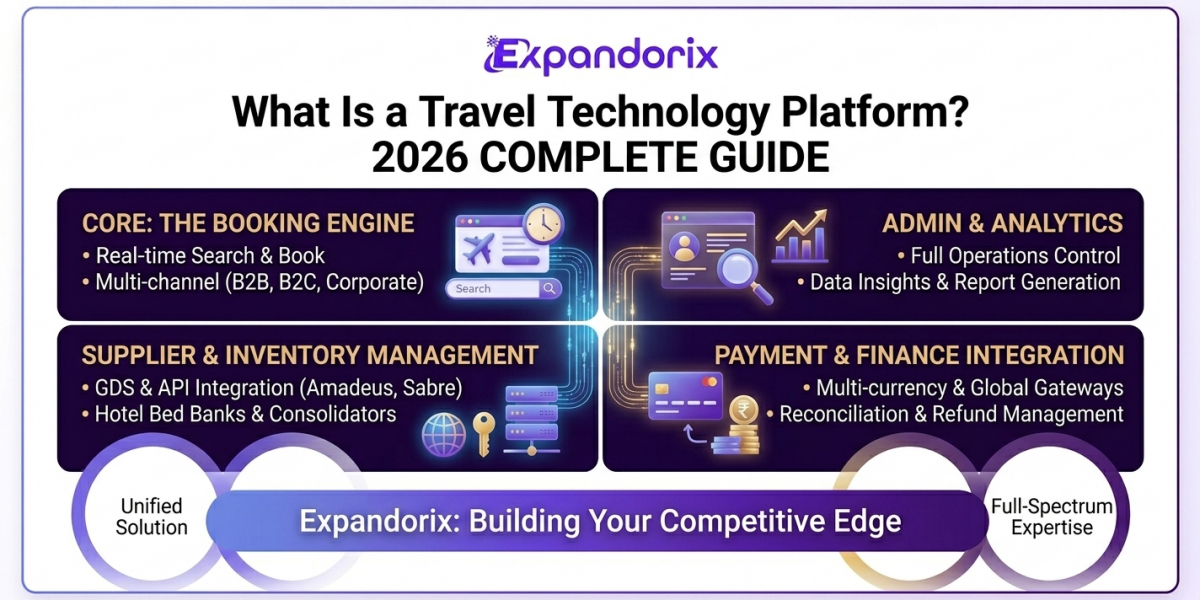
1. The Booking Engine
The booking engine is the heart of any travel platform. It is the component that receives a traveler's search query, fetches live inventory and pricing from connected suppliers, applies business rules and markups, and presents results in a clear, searchable interface.
A high-quality booking engine must be fast — returning results in under two seconds even when querying multiple suppliers simultaneously. It must be accurate — showing real-time availability and pricing rather than cached, outdated data. And it must be intelligent — applying dynamic pricing rules, promotional fares, and personalised recommendations based on user behaviour.
The booking engine handles different verticals depending on the platform: flights (including domestic, international, one-way, round-trip, multi-city), hotels (including room type selection, meal plans, cancellation policies), holiday packages (combining flights, hotels, transfers, and activities), transfers and car rentals, cruise bookings, and visa services.
2. Supplier and Inventory Management
A travel business is only as good as the inventory it can access and the prices it can offer. The supplier management module is responsible for connecting your platform to all your inventory sources and keeping that inventory synchronised in real time.
This module handles direct supplier connections (hotels, airlines, car rental companies), API integrations with third-party aggregators, GDS connections for global air and hotel inventory, bed banks like Hotelbeds or W2M, and consolidator rate feeds.
Beyond connectivity, the supplier management layer also handles markup rules (applying different margins for different markets, booking channels, or customer segments), blackout dates and availability rules, contract rate management, and supplier performance reporting.
3. GDS and API Integration Layer
The Global Distribution System (GDS) integration is one of the most technically demanding components of any travel technology platform. GDS systems — primarily Amadeus, Sabre, and Travelport — are massive data networks that connect airlines, hotels, and other travel suppliers to travel agents worldwide.
Integrating with a GDS gives your platform access to near-universal flight inventory, including the ability to book codeshare flights, process complex itineraries, issue e-tickets, and manage post-booking changes and cancellations.
Beyond GDS, modern travel platforms also integrate with a wide range of third-party APIs: hotel content APIs (for room descriptions, photos, and amenities), rate APIs (for live pricing and availability), activity and experience APIs, transfer and ground transport APIs, travel insurance APIs, and visa and documentation APIs.
Building and maintaining these integrations requires deep technical expertise in XML, JSON, SOAP, REST, and the proprietary protocols of each supplier. This is an area where experienced travel tech companies add enormous value over generalist software developers.
4. Payment Gateway Integration
In the travel industry, payment processing is unusually complex. Bookings involve high-value transactions, international currencies, split payments (where partial payment is taken at booking and the balance later), refunds and cancellations, and fraud prevention requirements.
A robust travel technology platform integrates with multiple payment gateways — Stripe, PayPal, Razorpay, CCAvenue, and others — to support different markets and payment preferences. It also handles multi-currency pricing and settlement, 3D Secure authentication for fraud prevention, automated refund processing, and comprehensive payment reconciliation reporting.
5. Admin and Agent Management Panels
Behind every great customer-facing travel platform is a powerful backend administration system. This is where your operations team manages the platform, configures business rules, monitors bookings, and handles exceptions.
Key admin panel features include user and role management (super admin, branch manager, agent, sub-agent), markup and discount configuration by market, channel, or product, booking management and manual override capabilities, supplier contract management, financial reporting and reconciliation, and customer communication tools.
For B2B platforms specifically, the agent management panel is critical. It allows you to onboard and manage a network of travel agents, assign credit limits, configure commission structures, track performance, and provide agents with their own white-labelled booking portal.
6. Analytics and Reporting
Data is the fuel of a modern travel business. A good travel technology platform includes comprehensive analytics capabilities: booking volumes by channel, market, and product; revenue and margin reporting; supplier performance metrics; customer acquisition and retention data; search-to-booking conversion rates; and abandonment analysis.
Advanced platforms use this data to power AI-driven features like personalised recommendations, dynamic pricing optimisation, and predictive demand forecasting.
Travel Technology Modules: How They Work Together
One of the distinguishing features of a mature travel technology platform is the modular architecture. Rather than being a monolithic system that must be replaced entirely if one component needs upgrading, a well-designed travel tech platform is built from independent modules that communicate through well-defined APIs.
This means you can start with a core booking engine and payment system, then add modules over time — a loyalty programme, a mobile app, a corporate travel module, an AI-powered recommendation engine — without rebuilding from scratch.
Common travel technology modules include:
The Itinerary Management Module, which allows users to build, view, and share detailed day-by-day travel itineraries. This is particularly important for tour operators and DMCs whose products involve complex multi-day experiences.
The Voucher and Documentation Module, which automatically generates booking vouchers, hotel confirmations, flight e-tickets, and travel itinerary PDFs upon successful booking. This eliminates manual document generation and reduces errors.
The Loyalty and Rewards Module, which tracks customer bookings, awards loyalty points, manages reward redemption, and drives repeat business through gamified incentives.
The Corporate Travel Module, which adds policy management (approved airlines, hotel categories, spend limits), approval workflows, expense integration, and detailed travel spend reporting for business travel programmes.
The Ancillary Services Module, which allows travellers to add extras to their booking — seat selection, baggage upgrades, travel insurance, airport lounge access, visa assistance — driving incremental revenue per booking.
The Multi-Language and Multi-Currency Module, which adapts the platform interface and pricing to different markets, supporting regional languages, local currencies, and market-specific payment methods.
The Technology Stack Behind Modern Travel Platforms
Understanding what technology powers a travel platform helps you evaluate build quality and long-term viability. Leading travel tech companies use a combination of:
Frontend technologies like Angular, React, and Vue.js for fast, responsive user interfaces. These frameworks enable dynamic search interfaces that update results in real time without full page reloads.
Backend systems built on Node.js, Java Spring Boot, Python, or PHP Laravel for high-performance API handling, business logic, and database management. The backend must be capable of handling concurrent requests from thousands of users simultaneously.
Cloud infrastructure on AWS or Azure, using containerisation with Docker and Kubernetes to enable auto-scaling — so the platform can handle peak demand during holiday seasons without performance degradation.
Database systems including MySQL for transactional data, MongoDB for flexible content and configuration data, and Redis for caching frequently accessed data like search results and pricing to improve response times.
This is the exact technology stack used by Expandorix in building its travel technology platforms — combining proven enterprise technologies with modern cloud-native architecture to deliver platforms that are fast, secure, and scalable.
How to Choose the Right Travel Technology Solution
With so many travel tech companies claiming to offer the best platforms, choosing the right development partner requires careful evaluation. Here are the key criteria to apply.
Domain expertise matters enormously in travel technology. Building a booking engine is not like building a standard e-commerce site. GDS integrations, fare rules, availability caching, PNR management, and dynamic packaging logic require specialists who have done this before. Ask potential partners for specific examples of travel platforms they have built and deployed.
Integration capability is non-negotiable. The value of your platform depends directly on the richness of your inventory, which depends on how many suppliers and APIs you can connect to. Evaluate your potential partner's track record with GDS integrations (Amadeus, Sabre, Travelport), bed bank integrations (Hotelbeds, W2M), and payment gateway integrations for your target markets.
Scalability architecture determines whether your platform survives your own success. A platform that works perfectly at 100 bookings a day but crashes at 1,000 is not a platform — it is a liability. Ask technical questions about load testing, auto-scaling capabilities, and database architecture.
Security and compliance are critical given the sensitive financial and personal data handled by travel platforms. Look for partners with experience implementing PCI DSS compliance for payment processing, GDPR-aligned data management practices, and robust security testing protocols.
Post-launch support is often overlooked in the excitement of building a new platform, but it is where many technology partnerships succeed or fail. Travel platforms require ongoing maintenance, supplier integration updates, performance optimisation, and feature development. Choose a partner with a clear, responsive support model.
Expandorix: Building Travel Technology Platforms That Drive Real Growth
Expandorix is a technology-driven platform development company with 18+ years of combined travel technology expertise. Based in Noida, India, Expandorix specialises in building custom travel technology platforms for OTAs, travel agencies, tour operators, DMCs, and travel startups.
What sets Expandorix apart is the combination of deep travel domain knowledge and modern software engineering. Their team understands not just how to write code, but how the travel industry actually operates — the complexity of GDS integrations, the nuances of fare rules, the operational workflows of travel agencies, and the expectations of modern travellers.
Expandorix's travel technology platforms are built on a scalable, modular architecture that allows businesses to start lean and grow fast. From a custom booking engine with real-time GDS connectivity, to a full-featured B2B portal with agent management and white-label capabilities, to a mobile-first consumer booking app — Expandorix designs and builds platforms that are ready for the real world.
The typical engagement timeline for a travel platform is 8 to 20 weeks, depending on the complexity of features and integrations required. Expandorix follows a four-stage development process: Discovery and Planning, UX and Architecture Design, Development and Integration, and Launch and Optimisation.
If you are ready to build a travel technology platform that drives bookings, scales confidently, and positions your business for long-term growth, Expandorix is the partner to talk to.
Frequently Asked Questions
What is the difference b/w a travel booking engine and a travel technology platform?
A booking engine is a single component — the part of the system where users search and book. A travel technology platform is the complete system, including the booking engine, supplier management, payments, admin tools, analytics, and all other modules.
How much does it cost to build a travel technology platform?
Cost varies significantly based on features, integrations, and scale. A focused MVP platform for a travel startup might take 8–12 weeks to build, while a full-featured OTA platform with multiple GDS integrations and mobile apps could take 16–20 weeks or more. Contact Expandorix for a detailed project assessment and estimate.
Can a travel platform be built to support multiple business models simultaneously?
Yes. Many platforms are designed with a B2B2C architecture, serving both travel agents (who log in via a trade portal) and direct consumers (who book via a consumer website) from the same backend inventory and management system.
Do I need my own IATA accreditation to use a travel platform with GDS integrations?
Not necessarily. Many businesses operate as sub-agents under a consolidated IATA accreditation, or use their GDS credentials through a host agency. Expandorix can advise on the right commercial model for your situation during the discovery phase.
What ongoing costs should I budget for after launch?
Ongoing costs typically include cloud hosting and infrastructure, GDS transaction fees, payment gateway processing fees, software maintenance and support, and periodic feature development. Expandorix provides transparent post-launch support packages.
Conclusion: Technology Is Not Optional — It Is Your Competitive Edge
The travel industry's most successful companies in 2026 are not the ones with the biggest marketing budgets or the most experienced salespeople. They are the ones with the most capable, scalable, and user-friendly technology platforms.
A travel technology platform is not an IT project. It is a strategic business investment that directly determines how many bookings you can process, how efficiently your team operates, how satisfied your customers are, and how fast your business can grow.
Whether you are building a brand-new travel startup or modernising a legacy travel business, the right technology platform can transform your operations and unlock growth that simply is not possible any other way.
Expandorix
1 posts
-
 Chinese supercomputer leapfrogs best US machines to be ranked world’s fastest
China’s LineShine debuts at number one in Top500 – a list sometimes viewed as a national measure of global tech prowess
-
 Will California’s billionaire tax proposal make it to ballots?
Despite more than double the needed number of signatures to qualify for ballot, there’s uncertainty it’ll make it to voters
-
 Met to expand use of live facial recognition into central London by Christmas
Technology to be used in six more areas next year as critics say tens of thousands of people will be forced into ‘digital police lineup’
-
 HR consultant wins English court case using AI lawyer in apparent legal first
Barrister who was given material produced by Garfield AI says advocacy at trial ‘remained fundamentally human’
-
 Two Britons plead guilty to £39m 2024 cyber-attack on Transport for London
Thalha Jubair and Owen Flowers, linked to the Scattered Spider hacking group, change pleas on first day of expected six-week trial
-
 AI models that can take down governments and business months away, rare Five Eyes statement warns
Signal agencies in Australia, the US, the UK, New Zealand and Canada sound alarm after Trump blocks foreign nationals from Anthropic’s Fable AI model
-
 Thirsty and power hungry: Australia is in the middle of a datacentre boom – but not everyone is convinced
They’re a key part of the digital and AI economy, but they come at a high environmental cost and offer few operational jobs
-
 Brands using AI-generated influencers to promote products on social media
Investigation finds AI content that purports to show genuine customers, prompting calls for greater transparency
-
 Key Trump allies and Musk on leaked list for secretive Peter Thiel retreat
Figures including Jared Kushner and Scott Bessent named in directory of Dialog participants that was exposed online
-
 A viral doomsday scenario aims to shake Europe out of its AI complacency
A speculative thought-experiment warns the continent could pay a heavy price for lagging behind the US
-
 Derbyshire police officer investigated over AI-generated ‘evidential material’
Unidentified officer removed from frontline duties in the first known case of its kind in the UK


