‘They have nothing else to lose’: Delaney Hall hunger strikes are a hallmark of resistance in detention

By Fabiola Cineas • June 7, 2026 • US news
As protests flare at New Jersey’s Delaney Hall, Jessica Ordaz examines the US’s complex relationship with migration and detention
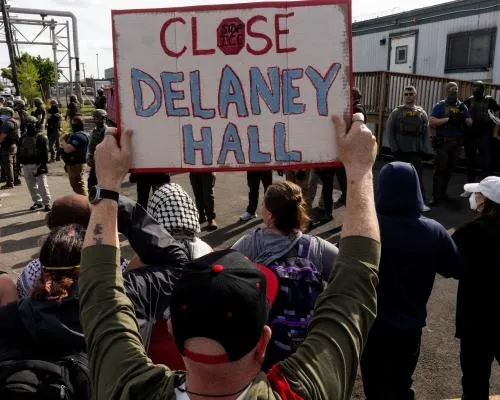
For more than two weeks, at least 300 detainees at the Delaney Hall immigration detention center have been on a hunger and labor strike. They describe “horrible” conditions at the Newark, New Jersey, facility: spoiled food, inadequate medical care and poor living conditions. Others have alleged physical abuse by guards, including being beaten and pepper-sprayed by a riot squad, causing some detainees to be rushed to the hospital. They’re calling for a meeting with the New Jersey governor, Mikie Sherrill, to urge the immediate release of all detainees from the privately operated 1,000-bed center. As of now, the Department of Homeland Security has partly restored family visitation at the center and released pregnant detainees. To raise the alarm, protests have persisted outside Delaney, and violent clashes between demonstrators and law enforcement officials have escalated. Immigration and Customs Enforcement (ICE) agents have wielded batons and used pepper spray and stun guns against protesters, journalists and a US senator. Federal authorities arrested demonstrators on allegations of assaulting law enforcement officers, and Sherrill deployed the New Jersey state police to the protests, leading to the arrests of more than 60 people in a single night. Meanwhile, ICE officers abruptly transferred Martin Soto, a detainee held in solitary confinement for being a suspected strike leader. Soto’s story, and that of the hundreds of detainees on strike, fits into a long history of immigrant incarceration – and how detainees resisted – said Jessica Ordaz, a historian and professor of ethnic studies at the University of Colorado Boulder and the author of The Shadow of El Centro: A History of Migrant Incarceration and Solidarity. Strikes have been reported at other facilities across the country, including in New Mexico and California, where detainees are protesting over water quality, mold and a lack of medical care. “The conditions we are seeing today have been present for generations,” said Ordaz. “And there have always been protests from inside, but it’s the same narrative and the system of immigration control hasn’t been curtailed.” The Guardian talked to Ordaz about the conditions at Delaney Hall, the history of hunger and labor strikes at detention centers, and why repression and resistance persist in tandem. What is your reaction to what you’re seeing at Delaney Hall in Newark? As a historian of migrant incarceration, it’s maddening because many of the elements we are seeing today – from folks being detained and treated like shit to sometimes being murdered, because of a lack of food or medical supplies, to protest repression – happens decade after decade after decade. The conditions haven’t changed. It’s the same narrative of migrants just being given ibuprofen for major health conditions, for example. The only change is that the system of immigration control has gotten more resources and power and has not been curtailed in any way. Can you walk me through some of that history? What moments stand out to you as especially egregious and when detainees fought back? This goes back to when the policing of migration became more institutionalized with the passage of anti-immigrant laws specifically targeting Chinese immigrants along the US-Mexico border in the 1800s. The conditions we’re seeing today, at centers such as Delaney Hall, have been rampant from the mid-1800s. In my book, I focus on El Centro, which was representative of other centers across the country. It started as a camp for a service processing center in 1945, according to the government. The use of undocumented Mexican labor to build the very prison that would imprison, if not them, their family members, their future generations, is a big part of immigrant incarceration and why strikes began as a tool of resistance. Labor plays such a big role – in order to have this place of incarceration, the federal government felt very comfortable using forced labor. They would threaten them and say, “We’re not going to give you jobs” or “We’re not going to give you food” or “We’re gonna deport you” or “We’re gonna hurt you physically”. They were basically held captive in the 1940s, and that story continues today, since in some facilities, folks are paid two cents for their labor. There’s a big economic thread, a forced-labor thread, and a racial capitalism thread that has existed at El Centro from the 1940s to the present that is happening across the entire detention system. Can you say more about the labor component? How has forced labor led to resistance? Escaping was the earliest form of protest. In the 40s, they took the predominantly Mexican migrant population into areas along the [southern] border to help with cleanup, land maintenance or to gather materials to bring back to the detention center. That’s where INS [Immigration and Naturalization Service] found themselves frustrated, according to the records: of course, people tried to escape, and in a lot of cases, they did so successfully because they were so close to the US-Mexico border. And at that point, a lot of the detainees were repatriating in a way, too. What kinds of protests followed? It’s around the 1960s when we see an uptick of sources that talk about protests via petitions and hunger strikes and advocating with lawyers by writing their testimonies as forms of resistance. So there’s a tradition of people becoming aware of the kinds of tactics that are “successful”. This timeline coincides with the kind of uprisings that took place across other kinds of prisons in the US in the 1970s and the civil unrest that took place across other areas of the country as well. And what is the history of hunger strikes as a resistance tactic? At El Centro, the Bracero program, which was a labor program set up by the US and Mexican governments to let millions of Mexican men enter the country legally on short-term work contracts, played such a pivotal role because El Centro was one of the processing centers for the program. So a lot of braceros [the historical term for the laborers in the program] were processed into El Centro and worked in the Imperial Valley in agriculture. From there, food became one of the main grievances that Mexican laborers had because they were essentially fed burritos, which maybe some of us consider a Latinx foodway today, but at the time, a lot of migrants were coming from different states where that was not their traditional food. There was quite a bit of protest. They had to pay for the food, and then the food was the cheapest thing that you could possibly feed someone, to lower costs and increase profit in immigration detention centers. And what’s still true today is that they are given really low-quality, low-nutrient food, not enough food, or food that’s actively making them sick. Food is often used more as punishment. How bad do conditions need to get for detainees to stand up and risk their lives by fighting for better conditions and to be released? It’s always been that bad. It’s mostly a matter of resisting to a level that gets the news of the conditions out to the public. There hasn’t been a period when conditions have been better. This is why sometimes detained people, whether it be migrants or detained people in prisons, turn to suicide or cutting. Ultimately, they’re literally giving up their lives, because they have nothing else to lose. They’re living through hell, and the idea is that if this gets out to the world, maybe the world will pay attention. Historically, have detainees been able to get their demands met? There were some tangible changes that were made [at El Centro], but if you’re asking how things have changed 20-30 years later, things have regressed instead of progressed. Anyone who’s been to the Imperial Valley knows that in the summer, it is utterly hot. And at the time, everyone at El Centro was not allowed to be indoors during the day. At peak heat hours, they were corralled in an outdoor space with no shade. So one of their grievances was: “Can you give us shade? Can you give us time to be indoors because we’re dehydrated?” They did get granted that one thing. But in the end, some people were deported, transferred or ended up in the hospital with severe wounds. The trauma that causes lasts a lifetime. That was it – that was the success from a tangible perspective. It sounds like it has taken a lot of different efforts for things to change just marginally. Talk to me about a multi-tactic approach. It definitely takes a multi-tactic approach. At El Centro, solidarity between the inside and outside was a big part of the story. There have been so many moments when prisoners, whether they be migrants or not, resist or actively protest or have demands, but the powers that be don’t bend unless they feel like they have to. Usually, what that means is they get a lot of pressure from the outside. For the prisoners inside, it’s hard to say that they should do this or that since they’re just surviving and resisting in whatever way they can. But for the outside activism, activists have been at this for a very long time. So what’s worked in the past is turning to a new generation of folks. The movement has always needed people to be everywhere: people who are working with politicians, people who are going to do a sit-in in the middle of the freeway to get the attention of the public. Solidarity has been a big part of the strategy, even solidarity between various organizations that might initially have different goals. We don’t see widespread systemic change immediately, but activism can get one person released, and then another person released, and maybe one less resource for ICE. That all minimizes the carceral state. Is there a bigger pattern we’re not seeing that history could teach us something about? Sometimes the focus is so present-focused, which I completely understand. But we have to look at the roots of the situation. We can take the idea of “abolish ICE”, for example. Well-informed folks call for this all the time. But it seems that people don’t have the understanding that ICE has existed for a very short period. Abolishing ICE doesn’t mean that all of this would be resolved. Greater contextualization would get us to think about the role of empire. We’ve been treating migrants and immigrants so terribly for so long, and we’ve been policing our borders. So we should be asking: “Why are people coming here?” The US has, for a very long time, been actively involved in recruiting migrants to the US. And it has also caused a lot of displacement around the world, whether it be economic or environmental. We need to get at the roots of why people migrate. That would allow for a deeper conversation of why this continues to happen, why we continue to see stories of repression and resistance inside of detention centers year after year.
Source: The Guardian
World News Today
33 posts