By Jamil Smith • June 19, 2026 • US news
‘We have come too far to turn around now,’ the monument on Alabama’s Montgomery Square reads
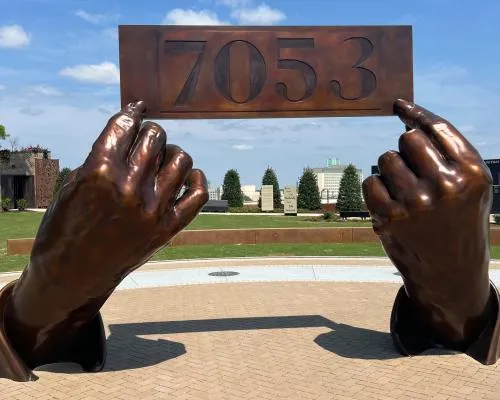
At the recently opened Montgomery Square in Alabama, bronze hands rise from the pavement, holding a placard against the sky. It reads 7053, the booking number displayed in Rosa Parks’s 1956 mugshot after she and other leaders of the Montgomery bus boycott were arrested. Often with booking numbers and mugshots, the viewer is trained to see criminality before circumstance, guilt before resistance. But at Montgomery Square, a number meant to reduce Parks to an arrestee, has been remade into a monument to what her arrest exposed. The square – an open plaza on Montgomery Street, where voting rights marchers passed in 1965 – is the newest of the four Legacy Sites that the Equal Justice Initiative (EJI) has built across the city. EJI founder, Bryan Stevenson, an attorney who has spent four decades representing the condemned and the wrongly convicted, said he built the square because he had come to believe that Americans “haven’t even fully appreciated what happened just 70 years ago during the civil rights era”. The timing of Montgomery Square’s opening was grimly prophetic in this regard. Weeks after its dedication, the conservative-majority supreme court gutted section 2 of the Voting Rights Act – the landmark legislation that prohibited racial discrimination in voting, for which civil rights activists had marched, organized and risked their lives. The decision opened the floodgates for an immediate surge in Republican attempts to redraw congressional maps and dilute Black political representation in Congress. Montgomery Square not only preserves the memory of Black resistance to racism in America, Stevenson said. It also asks what that memory demands of us, especially as the Trump administration and other conservatives in power work to erase the victories born from that era. Along the square’s exterior wall, in letters tall enough to read from the street, an inscription reads: “We have come too far to turn around now.” Stevenson said he added the line late. The dedication, he said, needed to declare something, not merely commemorate something. *** Stevenson, author of the memoir Just Mercy, has long argued that the United States has failed to build the kind of public memory around racial terror seen in Germany’s Holocaust memorials or South Africa’s apartheid museums. “We’ve never created spaces like that in this country that make us say never again to racial terror,” Stevenson said. “And because we never made that commitment, it just keeps manifesting itself.” EJI opened its first two sites in 2018: the Legacy Museum, which traces a detailed line from the Middle Passage, the forced voyage of enslaved Africans across the Atlantic Ocean to the US, to mass incarceration; and the National Memorial for Peace and Justice, which honors more than 4,400 victims of lynchings and other forms of racist terrorism. The Freedom Monument Sculpture Park followed in 2024, on the banks of the Alabama River, where enslaved people were once trafficked. Montgomery Square is now the fourth. The sites currently host around half a million visitors per year. For some visitors, the sites hold family trauma. Josephine Bolling McCall was five years old in 1947 when her father, Elmore Bolling – an entrepreneur, farmer and transporter in Lowndes County – was shot “six times with a pistol and once in the back with a shotgun”, McCall told me. Her research into his death found he was lynched, as she put it, for being “too prosperous as a Negro farmer”. “I grew up impoverished,” she said. Today, her father’s name is etched at the National Memorial for Peace and Justice. Soil from the site where he was killed – collected by three generations of his family – is preserved at the Legacy Museum. “We feel immersed and intimately connected,” McCall said. Unlike federal museums and public institutions now facing political pressure over how they present US history, EJI controls the stories told at its privately built sites. That gives Stevenson greater freedom to tell that history without sanding down its indictment. “It causes people to talk about things,” he said. “People start admitting, ‘My grandfather was in the Klan or my uncle was really racist.’ And it just changes the way people begin to appreciate how that history can haunt them if it doesn’t get addressed.” In March, Stevenson described listening, while driving back from the funeral of John Perkins, a civil rights leader, to an interview with someone spreading the great replacement theory, the racist conspiracy falsely alleging that white Americans are being deliberately displaced by demographic changes. What struck him was not simply the bigotry, but the smallness of the injury being imagined. “I think they think the history of racial injustice is like a paper cut,” Stevenson said. “They don’t dispute that it was wrong. They don’t dispute that it was painful, but they grossly underestimate the nature of the injury. I think it’s a severe wound that’s infected, and we’re not going to recover from this wound if we don’t treat the infection.” *** The fight over memory has always been a fight over authority: who gets to define the injury, who gets to minimize it and who gets to teach the next generation what happened. After Florida announced a state-developed, “anti-woke” alternative to AP US History, Stevenson said: “It’s like the government turning over to the tobacco industry all of the education that everybody will receive about smoking.” He then used a different metaphor to describe how too many people perceive and compress the struggles behind the civil rights movement. “When I hear people talk about the civil rights movement,” Stevenson said, “it sounds like a three-day carnival. On day one, Rosa Parks didn’t give up her seat on the bus. On day two, Dr King led a march on Washington. And on day three, we changed these laws.” Montgomery Square resists that flattening. The bus boycott was not a single act by a single woman. It was the accumulated response to daily humiliation, physical violence and degradation. Cooks, maids, laborers and domestic workers stayed off Montgomery buses for more than a year, sacrificing wages they could scarcely afford to lose. Many gave up significant portions of their annual income through fines, retaliation and the basic cost of resisting. The site insists that the civil rights movement was not simply inspiring. It was costly. It was collective. It was dangerous. Perhaps most of all, it did not end the work. For Stevenson, the recent supreme court decision proves that. The court did not create the Voting Rights Act – Congress did, after people in Selma, Montgomery and communities across the South forced the federal government to respond. The law was born from organizing and pressure, not judicial generosity. Elected officials didn’t lead the bus boycott. Preachers, maids, cooks, undertakers, teachers, students and other people made it happen. These were people who had nothing left to give but their refusal. Montgomery Square is there for them and for us. When Stevenson, one of the most prominent lawyers in America, says that “we can’t rely on the law to solve the problems that we have,” it does not sound like despair. It sounds like a reminder of how the victories now being threatened were won in the first place. The work, Stevenson said, is a relay: one generation carrying it as far as it can before handing it to the next. “At every moment,” he said, “the baton was passed with a clear directive: ‘You have got to continue this race. We have not won the racial justice we are seeking yet.’” At Montgomery Square, that directive takes physical form: the booking number displayed beneath Rosa Parks’s face in a 1956 mugshot, now lifted skyward for all to witness. The question remains what visitors do after they see it.
Source: The Guardian

World News Today
240 posts
-
 Desi chudai ka video dekho or sukoon pao
desi chudai ka video ki romantic kahani
-
 Genuine vs Compatible: The Truth About Ricoh Toners and Cartridges in Qatar
Choosing Ricoh toners and cartridges in Qatar affects yield, warranty, and machine life. Compare genuine and compatible options with real performance data.
-
 Your Gateway to Global Markets: Get IEC Registration Today
Your Gateway to Global Markets: Get IEC Registration Today
-
 Grow Smarter with Professional ISO Registration
Grow Smarter with Professional ISO Registration
-
 Sell Smarter, Earn Bigger: The GeM Portal Advantage in 2026
Sell Smarter, Earn Bigger: The GeM Portal Advantage in 2026
-
 FSSAI Registration 2026: Your First Step to a Trusted Food Business
FSSAI Registration 2026: Your First Step to a Trusted Food Business
-
 FSSAI Certificate: The Key to Food Business Success in India
FSSAI Certificate: The Key to Food Business Success in India
-
 Udyam Registration Online: Your First Step Toward Business Success
Start Strong and Grow Fast with Udyam Registration Online: Your First Step Toward Business Success
-
 Grow Your Business Faster with Udyam Registration Online
Grow Your Business Faster with Udyam Registration Online
-
 Start Strong and Grow Fast with Udyam Registration
Start Strong and Grow Fast with Udyam Registration
-
 Passport Registration Online Secrets Every Applicant Should Know
Passport Registration Online Secrets Every Applicant Should Know


