By Joseph Palmer • June 19, 2026 • Sport
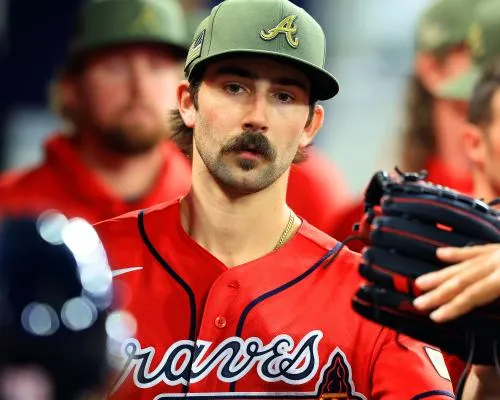
The Braves pitcher has always been different from the average baseball player. He talks to Joseph Palmer about his motivations on and off the field
Spencer Strider made an impression in 2022, his first full season in Major League Baseball: he was runner-up for National League Rookie of the Year. In 2023 he was ever better, leading the majors in wins and strikeouts and earning a spot on the All-MLB first-team. But what set him apart from many of his peers wasn’t his athletic ability but his life away from baseball. In a sport that is often socially conservative, the Atlanta Braves pitcher was a vegan Bernie Sanders supporter who was just as likely to discuss indie music as his fastball. Strider, who has been troubled by injuries in recent seasons and is set for another lengthy spell away from baseball in 2026, credits coach Tommy Pharr of the Christian Academy of Knoxville, his high school, as the original source for much of his mindset. He calls Pharr “probably the most influential person for me”. “[The lessons he taught me] led me … to never be satisfied with the depth of knowledge that I have at any given moment,” he says. “That it’s important to pursue what you don’t know, because it may be of use to you.” This openness permeates Strider’s attitudes toward many aspects of life – including his veganism. “I started [eating vegan] in 2019 when I was rehabbing from Tommy John surgery,” he says. “I had blood pressure that I was medicated for, [which] I always thought was a little peculiar for a 20-year-old. I had issues sleeping … and then there were also a lot of ethical and environmental concerns that I was sympathetic towards. I decided one day to try it and, within two weeks, I was off the hypertension medicine.” Strider is far from the only professional athlete to cite a vegan diet’s health benefits. His commitment to discussing veganism’s broader ethical arguments, however, is less common. “I understand that people have differences of opinion but, nonetheless … I think factory farming is certainly problematic and not exactly what we’re supposed to be doing to the planet,” Strider says, before clarifying that veganism is just one of many ways to address such issues. “I’m very conscious to the idea that any improvement, while it may seem insignificant, is still worthwhile. For me, it’s easier to be fully plant-based, but I think everybody can have a marginal improvement [around the ethics of the meat industry] that would, collectively, be great for the environment and the planet.” Championing of a vegan diet is often associated with left-leaning politics and Strider has expressed admiration for Sanders. Given that, by some measures, baseball players are the most politically conservative athletes among the “Big Four” North American sports leagues, this too makes Strider an unusual fit for his profession. (In typically thoughtful fashion, he refuses to make such broad observations about this peers’ politics, nothing that “there’s a diverse group of personalities around here.”) “I don’t know that I would single anyone out,” Strider says when asked if there are any other politicians he admires. He was speaking before a series of baseball players refused to join in Pride celebrations. But it is clear which side of the argument Strider, who spoke at the Braves’ Pride Night this month, is on. “Plenty of things are antiquated. I think about homophobia, racism, sexism, those types of structures and behavioral systems that have existed for a long time – they’re eventually going to subside entirely,” he says. “My position is that: to be ignorant to the reality that [homophobia and racism] are wrong is a misguided and unnecessary approach … There’s no reason to pretend that they’re not wrong or not harmful.” While Strider’s observations on politics and culture are refreshing, such interests do not occupy all his time off the field. Instead, talking with Strider feels a bit like catching up with an old friend – the conservation jumps from the serious to the lighthearted with ease. “I’m a big music fan. I like playing music, listening to vinyl, listening to music,” says Strider, who has played guitar since he was a teenager. With a laugh, he refuses to share the name of his high school band. In his own words, his tastes are “middle of the road”. Strider mentions his fondness for millennial indie darlings such as Vampire Weekend, the Strokes and Mac DeMarco before namechecking the slightly more obscure acts that reveal his preference for riffy basslines and quasi-psychedelic sounds. He cites Patrick Taylor of Trash Panda as both a favorite musician and someone who his connections through the Braves have allowed him to get to know personally. “He’s just an unbelievable musician and awesome creative mind. He’s somebody I’ve really enjoyed getting to be around [and] a really cool relationship for me,” Strider says. “There’s a lot of acceptance and freedom that the [the music] industry could share with the rest of the country and the world.” Despite his interests outside baseball, Strider isn’t one of those athletes who views his profession as just a paycheck. In addition to music and climate change, he discusses the nuances of his craft with enthusiasm. He thinks recent changes to MLB (pitch clocks and the automated ball-strike system, etc.) haven’t gone far enough in improving the game. “I think teams should be able to construct rosters however a team deems necessary for their own strategy,” Strider says. “Right now, it’s limited to 13 pitchers and 13 position players [active on each MLB roster]. If the Atlanta Braves want to have 15 pitchers on their roster, they should be able to … Even if it’s [just] for a series or a week. I think that could lead to more diverse strategies and would be good for the game.” This perceived shortcoming has yet to hurt the Braves’ season – they are top of the NL East and have one of the best records in the majors. Team success, however, has not always translated into individual success for Strider. He hasn’t pitched a full season since 2023 and it seems this will be another campaign ruined by injury. Perhaps predictably, Strider – who was speaking before his most recent injury setback – approaches these challenges mindfully. “Injuries are always going to be a part of playing, and I try to do as much as I can to minimize them and minimize the length of them,” the 27-year-old says. “I try to keep the mentality that you know, ‘Wherever you’re at, good or bad right now in this very moment, is not the ultimate definition of you.’ I don’t define myself by any singular moment, so I try to keep him to keep that long-term perspective and know that my career, and what I want out of it, will be defined by the collective [experience].” At the very least, it’s clear that Strider won’t be bored off the field as he heals.
Source: The Guardian

Sports Update
199 posts
-
 Satta: Your Path to Winning Big with Sattamatkateez
Satta is a game where you choose numbers and bet on them, hoping to match the winning combination. Simple to play, yet full of excitement, Satta offers endless opportunities to win, especially when you play with sattamatkateez.
-
 Lang Calendars 2025: A Year of Art and Inspiration
For many people, a calendar is more than just a tool for keeping track of days—it’s a daily source of inspiration. Lang Calendars have been celebrated for their high-quality craftsmanship, beautiful artwork, and functional design, making them a popular choice for homes and offices alik
-
 Lang Calendars 2025: A Year of Art and Inspiration
For many people, a calendar is more than just a tool for keeping track of days—it’s a daily source of inspiration. Lang Calendars have been celebrated for their high-quality craftsmanship, beautiful artwork, and functional design, making them a popular choice for homes and offices alik
-
 Lang Calendars 2025: Timeless Art and Practicality Combined
Calendars have always been more than just a tool to mark time. They reflect our personality, showcase our style, and serve as a piece of art we look at every day. Among the various calendar brands available, Lang Calendars 2025 stands out for its unique blend of artistic designs, functio


