Mystery of hit on Tren de Aragua leader: is it linked to US mining plans in Venezuela?

By Thomas Graham in Bogotá and Clavel Rangel in Miami • June 23, 2026 • World news
Trump boasted of assassinating Héctor Guerrero Flores but details are scarce and experts doubt it will harm drug trade
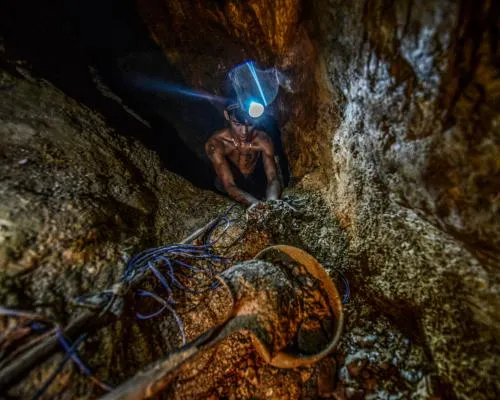
At 10am on 9 June, a huge explosion rattled Las Claritas, a ramshackle town on the edge of a vast goldmine carved out of the Venezuelan Amazon. “The blast was so powerful that my sister’s house shook, and she was 10 kilometres away,” said one miner, who asked to remain anonymous for security reasons. “Imagine the impact.” Immediately afterwards, helicopters began circling overhead, as if they were hunting something or someone. For days there was almost no information about what had happened. Then Donald Trump posted a video on social media, saying that it showed the assassination of Héctor Guerrero Flores, the leader of the Venezuelan gang Tren de Aragua. The aerial footage was just like the US strikes on alleged drug boats in the Caribbean and the Pacific – but with the crucial difference that it took place on Venezuelan soil, apparently among the illegal open-pit mines in the country’s far south. The joint operation between the US and Venezuela marked a watershed moment in the relationship between the former adversaries, who less than half a year ago were shooting at each other as the US military swooped on Caracas to capture the regime’s then leader, Nicolás Maduro. It is also the latest push by the US to expand its military strikes on criminal groups into countries across the region – and perhaps a first step towards preparing a lawless region for investment by mining companies. “I think this is an inflexion point,” said Bram Ebus, a consultant for the International Crisis Group. “We’ve seen US forces targeting alleged drug-trafficking vessels, but this is within the terrestrial boundaries of a country. And joint action with the US is massively symbolic for a country whose government rhetoric for decades had been about rallying against Washington.” The attack swung the spotlight on to the Orinoco Mining Arc, a vast and mineral-rich swathe of land by the borders with Guyana and Brazil, where hundreds of thousands of miners have flocked, many of them displaced people who lost their livelihoods during Venezuela’s economic collapse. Crime factions – including Venezuelan gangs such as Tren de Aragua, but also Brazilian groups and Colombian guerrillas – are the de facto state in much of the region, where for years criminals have struck deals with members of the Venezuelan regime to control mines, collect taxes and keep a brutal kind of order. “They destroyed whatever institutional order had existed,” said Américo de Grazia, a former member of the Venezuelan national assembly representing Bolívar state. But the future of the region has been in question ever since the Trump administration captured Maduro in January and replaced him with Delcy Rodríguez, giving her instructions to open up Venezuela’s natural resources to investment by US companies. Donald Trump announced the strike after days of Venezuelan military operations around Las Claritas, a hub of illegal mining in the state of Bolívar, with locals reporting gunfire and explosions as helicopters flew overhead. Tren de Aragua, which was listed by the US as a foreign terrorist organisation last year, is known to control Las Claritas. And its leader, known as Niño Guerrero, may have been hiding there. But the details of the operation that killed him – including when and where it took place – remain almost completely opaque. Authorities are also yet to provide proof that Niño Guerrero is dead, and it is unknown whether other Tren de Aragua figures were targeted, or whether civilians were killed or injured during the operations. “Trusted sources tell us that the [Tren de Aragua] leaders fled to Guyana, but we don’t know for sure,” said another miner from El Dorado, near Las Claritas. “We have heard reports of a lot of wounded people, some dead,” said Cristina Burelli, founder of SOS Orinoco, which has a network of sources on the ground. “But really, there’s no information. It’s unbelievable.” Also unclear is the precise nature of US involvement in the operation. Trump said the US “delivered” the strike. US media have variously reported that the CIA supplied the intelligence and even that the missile was launched by Joint Special Operations Command. That would mark the second US military action in Venezuela after the operation to extract Maduro – only this time it appears to have been done hand-in-hand with the same regime, and against a criminal organisation that Washington once accused Caracas of protecting. It also signals an expansion of the US military’s attacks on criminal groups in the region, which started with strikes on alleged drug boats in Caribbean and the Pacific, but have since spread to joint operations in Ecuador and now Venezuela, while Trump pushes for the same in Mexico. Experts suspect the strike in Venezuela also had the parallel purpose of preparing the area for investment by mining companies. The Orinoco Mining Arc holds not just gold, but rare earths and critical minerals such as nickel, copper, bauxite and coltan that are vital for industrial and military production. Since January, the Venezuelan regime has passed a mining reform to open the sector to foreign private capital, while the US has issued licenses allowing US companies to carry out transactions involving Venezuelan-origin gold. The huge gold deposits near Las Claritas are of particular interest. Canadian and US companies – Crystallex and Gold Reserve – saw their concessions there expropriated by Maduro’s predecessor, Hugo Chávez, and are still chasing the arbitration settlements. After the capture of Maduro, Gold Reserve announced its interest in returning to Venezuela. “I suspect the origin of this latest operation is that the United States wants the area cleared for Gold Reserve and Crystallex so they can regain control of the region,” said De Grazia, the former politician from Bolívar state. But Burelli estimates there are between 15 and 20 armed criminal groups across the Orinoco Mining Arc. “Getting rid of one guy does absolutely nothing to change the situation,” said Burelli. Last week the police chief of Las Claritas was found dead, killed by a bullet from his own gun. “I think this is the first kind of sign of revenge by people from Tren de Aragua,” said Burelli. Meanwhile, the criminal groups are just one part of a system that involves the Venezuelan state itself. As oil income collapsed, regime insiders turned to gold mining to raise money, allowing their cronies, among them military officers, to enrich themselves. “The Venezuelan army is so deeply entrenched in all these illegal economies that it’s difficult to see them completely flipping against the organised crime networks,” said Ebus. “Southern Venezuela is still an investor’s nightmare.”
Source: The Guardian
Guardian News World
301 posts
-
 Forty drown across France in heatwave and parts of Spain above 30C at night
France has its hottest night on record, 15 Italian cities under red heat alert and UN chief says London is ‘cooking’
-
 Nationalist group leaders agree to stop hoisting St George’s flags in Oxfordshire
Representatives of Raise the Colours appeared in court after local council accused them of intimidating staff
-
 New Trump book’s authors detail how they pried loose White House secrets: ‘We nearly killed ourselves’
Maggie Haberman and Jonathan Swan, the reporters behind Regime Change, were up against an administration that is ‘very good at keeping secrets’
-
 Primary voting begins in New York, Maryland and Utah – US politics live
In New York, Mamdani has thrown support behind three congressional candidates and Super Pacs have been pouring money into a single race
-
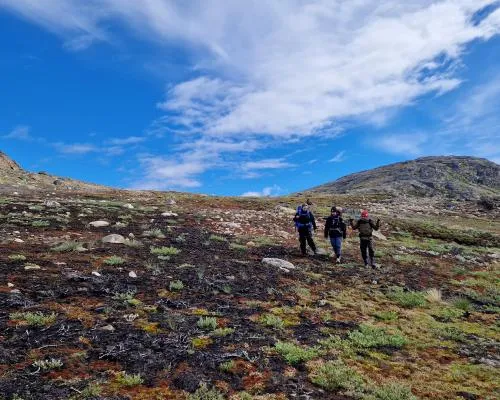 Scientists alarmed after two wildfires hit Greenland within a week
Researchers say it is ‘quite wild’ to see fires at such high northern latitudes happen so early in the year
-
 South Yorkshire police investigate video of officers appearing to shove teenage girls
Force describes footage of police response to incident in Rotherham as ‘nothing short of shocking’
-
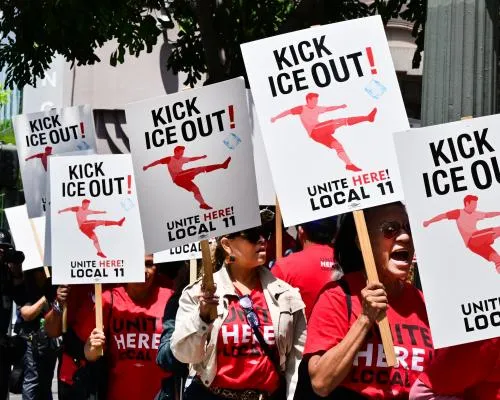 First Thing: Judge thwarts Trump administration attempt to overthrow LA ‘sanctuary city’ policy
Central California US district court rejected claim policy was ‘unconstitutional’
-
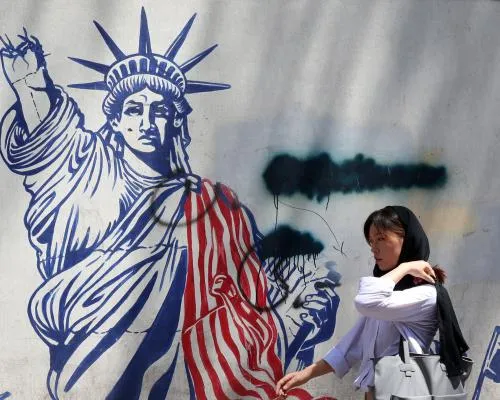 Middle East crisis live: Iranian ambassador warns it will respond to any Israeli attack in Lebanon
The Iranian ambassador to the UN in Geneva described Israeli attacks on Lebanon as a red line in negotiations
-
 Tuesday briefing: How might Andy Burnham bring his Makerfield magic to Westminster?
In today’s newsletter: Correspondents across the UK reveal the challenges that Labour’s newest MP will face from day one in the job
-
 ‘Geldof started flicking Vs at Farage’: the story of the Brexit campaign, told by those with a front-row seat
How five months in 2016 that encompassed Boris Johnson siding with Vote Leave, Jo Cox’s murder and David Cameron’s resignation shaped the UK’s future


