Digested week: Starmer is trying to carve out his legacy – but it’s not his to write


By John Crace • June 12, 2026 • UK news
Plus, Brexit at 10, dinner as protest, 100 best novels and not watching the World Cup (yet)
Monday We’re approaching the 10-year anniversary of the Brexit referendum. Documentaries are being aired and newspaper features are being written. But one thing seems to be missing. Why aren’t all those big names who campaigned for Brexit back in 2016 now shouting from the rooftops about what a great success it has been? It’s almost as if they are ashamed of it. Nigel Farage just moans about it having been done wrong. Although he isn’t particularly illuminating about what the right way would have been. Boris Johnson gave a few clips to the BBC in which he repeated a few tired anecdotes about the tennis match with David Cameron where Dave promised him a top job in return for backing remain. But on the long-term economic, social and international impact of leaving the EU? A wall of silence. I remember going to a press conference on the morning of 24 June at the Vote Leave headquarters. The event started half an hour late and I described Boris and Michael Gove looking like they had spent the night taking psychedelic drugs and woken to discover they had murdered their best friend. To this day, Boris insists it was Cameron’s fault for not having prepared the government for Brexit. Johnson still refusing to accept responsibility for his own actions. Polls now suggest that most people reckon Brexit has been a mistake. All that’s missing is some accountability. Tuesday It’s one of life’s ironies that prime ministers are usually remembered for the things they would rather forget. Tony Blair will be haunted by the Iraq war. Gordon Brown didn’t call an election in 2007. David Cameron carelessly lost the EU referendum. Theresa May lost her majority in 2017 and couldn’t sort Brexit. Boris Johnson will always be associated with lying about almost everything. Liz Truss has her mini-budget. Rishi Sunak got soaked outside Downing Street as he called a general election. Yet, none of this seems to stop them trying to define their legacy as they sense they are approaching their last months in office. The official line from No 10 is that Keir Starmer will lead Labour into the next election and will be running the country for another decade or so. But Andy Burnham appears to be on course to win next week’s Makerfield byelection and he hasn’t given up being mayor of Greater Manchester just to be a backbench MP. Deep down, Keir knows his days are numbered, which is why he is desperately trying to carve out a legacy that goes beyond numerous U-turns, taking free suits and glasses, and being a bit disappointing. This week, he used his speech at London Tech Week to talk tough to the social media companies about stopping children accessing sexual content on their phones and laptops. Only, it was very Keir for him to give the tech bros three months’ notice before introducing legislation. Three months he may not have. Starmer is also trying to create a legacy out of his defence investment plan, although that seems to be stalled as he can’t make the sums add up and his defence secretary, John Healey, has resigned. Like all prime ministers, Keir’s legacy is not his to write. Wednesday There’s something about a list I find irresistible. It brings out the nerd, the collector, in me. So like many of you, I became somewhat obsessed with the Guardian’s list of the 100 best novels. Not to the point of caring whether Middlemarch was ranked first or second, but to do a checklist of how many I had read, and to discover, to my shame, there were a handful of which I had never heard. I hope I’m not alone in being totally unaware of Pedro Paramo and Their Eyes Were Watching God. I was particularly pleased to see Daphne du Maurier’s Rebecca make the cut at 82, though personally I’d have put it above Henry James’s The Golden Bowl, which must rank as one of the dullest books I’ve ever read. People tend to get very sniffy about Rebecca, but I think it’s a modern masterpiece. The audacity of a book whose title character never once appears, except as a memory and a corpse, and whose narrator, the second Mrs de Winter, is never named. Then there is the journey on which Du Maurier takes us. Maxim admitting to killing Rebecca in a fit of jealous rage and yet maintaining the reader’s sympathy. Du Maurier’s only concession to conventional morality is a denouement in which it is revealed that Rebecca had cancer, couldn’t conceive a child, was going to die soon anyway and was trying to provoke Maxim into killing her. We end the book hoping Maxim and the unnamed second wife life happily ever after. This was too much even for the master of the noir, Alfred Hitchcock. For his 1940 screen adaptation, he had to change the ending to one where Maxim didn’t kill Rebecca. He thought the original was too much to ask of his audience. But Du Maurier could get away with it. I am hoping now for a top 100 opera list. But maybe we could go for a top 50. Mine would be headed by Mozart’s Marriage of Figaro, which I saw again earlier this week. The opera is quite simply the best farce ever written, accompanied by the best music ever written. I never tire of it. Thursday The World Cup finally got under way with Mexico playing South Africa. And for the first time in decades I did not watch the first game of the tournament. Not because I had a prior engagement, but because I simply couldn’t be arsed. I certainly wasn’t up at three the following morning to watch South Korea v Czech Republic. Canada and Bosnia-Herzegovina also gets the thumbs down. I haven’t even bothered to check who is playing over the weekend. The first game in the diary is Croatia v England next Wednesday. And that’s really only out of a misplaced sense of duty. It’s just that there is so much about this World Cup to dislike. At least in Russia and Qatar, the host countries made some kind of futile effort to pretend they weren’t dictatorships for the duration. The US – Donald Trump in particular – has made no attempt to conceal the fact that this tournament is being run exclusively on its own terms. And Fifa has highlighted its own corruption, its willingness to sell out football to the highest bidder, by letting the Americans do whatever they want. Ticket prices are exorbitant. There are still seats available on secondary sites for the first England game if you are mad or rich enough to shell out the best part of £700. Then there are the 48 teams – the extra 16 brought in just to generate more cash. The Somali referee who was refused a visa. The Iranian team that was sent to make its base in Mexico and only allowed into the US on the morning of its matches. Maybe in a couple of weeks I’ll find myself hooked in. I wouldn’t bet against it. But it will cost me some of my principles. Friday Minneapolis is back in the news, thanks mainly to a recent New York Times article about a restaurant – more a diner – called Modern Times. For a long time, Modern Times struggled to break even, but earlier this year it changed both its name to Post Modern Times and its funding model to one where customers pay what they want. Some customers, usually homeless people and those on welfare benefits, often pay nothing, while others pay, or in many cases deliberately overpay, what they think their meal is worth – the menu is standard, midwestern diner fare of pancakes, hash browns, eggs any which way etc. And now the restaurant is making a healthy profit, with some in hospitality wondering if this is a business model that might work for them. But here’s the curious thing. Dylan, the owner of Post Modern Times, didn’t switch to pay-what-you-want as a desperate, left-field attempt to increase profits; he did so as a form of political protest. Post Modern Times is located in the south of the city; six blocks from where George Floyd was murdered by a police officer, three blocks from where Renée Good was shot dead by an Immigration and Customs Enforcement agent, and a mere neighbourhood away from where Alex Pretti was shot dead by Customs and Border Protection officials. And like most people in Minneapolis – the city has always had a liberal, democratic heartbeat – Dylan was outraged about what Trump was doing to his home town. Not least that the taxes he generated from the food he sold were being used to fund the occupation of the city by 3,000 ICE agents. So by switching to payment by donation, Dylan was in effect exempting the restaurant from the tax system. Which has turned out to be a win-win for Post Modern Times. But you need to be patient if you want a table. My son-in-law Robert, who was born in Minnesota and has lived in Minneapolis almost all his life, decided to drop by for lunch this week. He was met with a long queue. But my wife and I are going to Minneapolis for a few days in a month’s time, so maybe we will get a chance to check it out. I will report back.
Source: The Guardian
Uk News Feed
68 posts
-
 Women held at much-denounced Ice detention camp sign on to hunger strike
Nearly 40 women detained at Delaney Hall join striking men and outline demands ‘rooted in basic human rights’
-
 Trung Quốc bắt công dân Mỹ với cáo buộc gián điệp
U Min Zin, công dân Mỹ đứng đầu tổ chức nghiên cứu về Myanmar, bị bắt với cáo buộc hoạt động gián điệp và gây nguy hiểm cho Trung Quốc.
-
 Has the US really carried out a secret mission to get oil through Hormuz?
Trump says hundreds of tankers have escaped Iran’s blockade. Data suggests shipments are increasing but many questions remain
-
 84% người Mỹ nghi chính phủ giấu thông tin về UFO
84% người Mỹ cho rằng chính phủ chưa công bố hết thông tin về UFO, 63% tin có sự sống ngoài hành tinh, theo khảo sát mới công bố.
-
 Cựu tổng thống Hàn Quốc Yoon Suk-yeol bị tuyên thêm 30 năm tù
Cựu tổng thống Yoon Suk-yeol, người đang thụ án chung thân, bị tuyên thêm 30 năm tù vì đã chỉ đạo vụ UAV Hàn Quốc xâm nhập Triều Tiên.
-
 First Thing: Iran peace deal remains elusive as choice of US targets draws legal questions
Trump claims strikes called off as deal is close, but Tehran denies agreement near, while legal experts question if US targets may be a war crime
-
 ‘I only want justice’: bereaved families seek closure one year on from Air India crash
Relatives of those killed on flight AI171 are still struggling to obtain answers about what happened
-
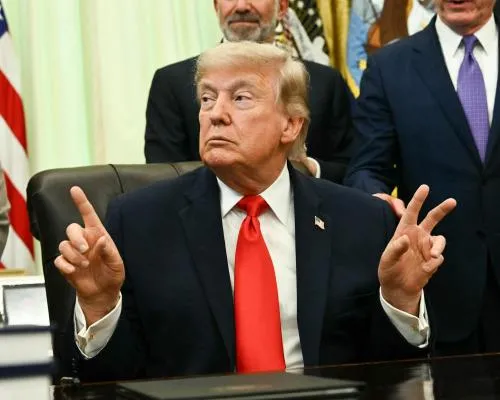 Fisa spy powers almost certain to expire after Congress fails to act – US politics live
Law due to expire at midnight tonight following unhappiness over Trump’s pick for intelligence chief
-
 Cuộc đời công chúa 'tài đức vẹn toàn' của Thái Lan
Công chúa Bajrakitiyabha, người vừa qua đời ở tuổi 47 sau ba năm hôn mê, được ca ngợi là một trong những thành viên tài đức vẹn toàn nhất của Hoàng gia Thái Lan.
-
 Phe cứng rắn ở Iran cáo buộc ông Trump 'đang tung hỏa mù'
Các quan chức theo đường lối cứng rắn ở Iran cho rằng tuyên bố sắp đạt thỏa thuận của ông Trump chỉ là chiêu tung hỏa mù nhằm làm Tehran mất cảnh giác.


