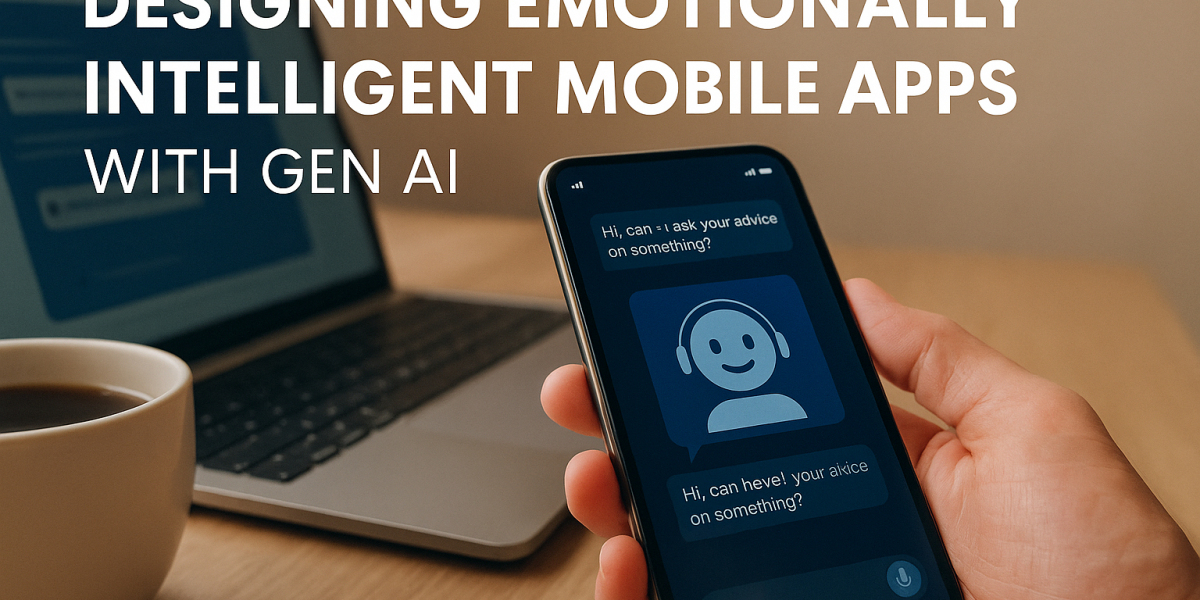
In the hyper-connected world of 2025, a mobile application is no longer just a tool; it's a companion, a service, and an extension of the user's daily life. The new benchmark for success isn't just functionality or a sleek design, but the ability to connect with users on a deeper, more human level. This is the era of emotionally intelligent mobile apps, and they are being powered by the revolutionary capabilities of Generative AI.
Generative AI (Gen AI) has moved beyond creating simple text and images. It now serves as the brain behind applications that can perceive, interpret, and respond to human emotions. This paradigm shift from static interfaces to dynamic, empathetic experiences is redefining the very essence of user interaction. Companies that embrace this technology are not just building better products; they are forging stronger, more loyal relationships with their customers. For any modern Mobile App Development team, understanding and implementing these principles is no longer a luxury—it's a necessity.
This comprehensive guide will explore the profound impact of Gen AI on app design, dissecting what makes an application emotionally intelligent, how Gen AI enables this intelligence, and the critical design principles and ethical considerations involved in creating these next-generation experiences.
An emotionally intelligent app is a digital product that goes beyond merely reacting to explicit commands. It is designed to understand the user's emotional state, anticipate their needs, and adapt its behavior to foster a sense of comfort, empathy, and effectiveness. This is achieved through a multi-faceted approach, analyzing a variety of user data and context, including:
Textual Cues: Analyzing the tone, sentiment, and word choice in user inputs.
Behavioral Analytics: Interpreting patterns in browsing, click rates, time spent on certain sections, and navigation to infer frustration or delight.
Contextual Awareness: Considering factors like time of day, location, and previous interactions to provide a more relevant and empathetic response.
The goal is to create an experience where the user feels seen and understood. This emotional connection leads to increased user engagement, higher retention rates, and a more positive brand perception.
Generative AI is the catalyst that transforms a simple, functional app into an emotionally intelligent one. Where traditional AI might be limited to pre-programmed responses based on sentiment analysis, Gen AI can create novel, context-aware, and emotionally resonant content in real-time. This is where the magic happens.
Gen AI models, like large language models (LLMs) and advanced speech-to-speech systems, are trained on vast datasets of human communication. This allows them to do more than just understand text; they can grasp the nuances of human expression, including sarcasm, irony, and subtle shifts in tone.
Real-time Response Generation: An AI-powered chatbot in a customer service app can now go beyond a canned response. If a user expresses frustration, the Gen AI model can craft an empathetic message acknowledging their feelings before offering a solution. This makes the interaction feel less like a conversation with a machine and more like a helpful exchange with a human.
Personalized Voice and Tone: Advanced voice AI can generate speech with specific emotions and styles. A meditation app, for instance, could use Gen AI to create calming, personalized audio narratives. A gaming app might use it to generate dynamic, emotionally charged dialogue for non-playable characters (NPCs) that changes based on the player's actions, creating a more immersive and believable world.
Gen AI is not just about communication; it's also about visual and interactive design. The user interface (UI) and user experience (UX) can dynamically adapt to a user's emotional state, creating an environment that supports their current needs.
Interface Adaptation: An app for a financial service might detect user stress from their hesitant clicks and frantic scrolling. In response, it could simplify the interface, highlighting only the most critical information and offering a clear, step-by-step guide to reduce anxiety.
Mood-Based Personalization: A music streaming app could use a user's listening history and explicit feedback to identify their current mood. Instead of just recommending new songs, Gen AI could generate a personalized playlist title like "Your Soundtrack for a Rainy Afternoon," offering a more thoughtful and resonant experience.
Gen AI takes personalization to a new level by generating content and suggesting features that are not just relevant, but also emotionally aligned with the user.
Content Generation: A journaling app, after analyzing a user's entries, could use Gen AI to generate a reflective summary of their week, highlighting moments of gratitude or success to promote positive thinking.
Proactive Suggestions: A fitness app, noticing a user's drop in activity and changes in their mood, might generate a personalized, motivating message or suggest a less strenuous, mindful exercise, showing it understands their current state and isn't just pushing a one-size-fits-all plan.
Building an emotionally intelligent app requires a different mindset. It's not just about adding a new feature but about integrating empathy and responsiveness into the very fabric of the design. Here are the core principles that a skilled Mobile App Development team must follow:
Every word, every piece of micro-copy, and every error message should be crafted with emotional awareness. The language should be empathetic, humble, and clear. A simple "Something went wrong" can be cold and frustrating. A more emotionally intelligent response, like "Don't worry, that happens sometimes. Let's try that again," builds trust and reduces anxiety. The tone of your app becomes its personality.
An emotionally intelligent app respects the user's rhythm. It knows when to offer a suggestion and when to remain silent. A constant stream of notifications and prompts can be overwhelming. Instead, the app should use contextual cues to time its interactions. A gentle nudge about an incomplete task at the right moment can be helpful, but the same message during a stressful time can be a major source of frustration.
Small, subtle design elements can have a big impact on a user's feelings. A successful completion animation, a calming progress bar, or a delightful sound effect for a task well done can reinforce a positive emotional connection. These micro-interactions are opportunities to build a sense of achievement and satisfaction, making the app feel more rewarding to use.
An app that uses context effectively feels more intelligent and trustworthy. This means using data like time, location, and past behavior to inform its actions. For example, a travel app might offer a personalized city guide in the morning, knowing the user is at their hotel, rather than sending a generic promotional message. This shows the user that the app is paying attention to their individual journey, not just treating them as a data point.
The power to understand and respond to human emotions comes with a great responsibility. The ethical implications of using Gen AI for emotional intelligence are profound and must be addressed from the earliest stages of Mobile App Development.
Emotional data—facial expressions, voice recordings, and sentiment analysis from text—is some of the most sensitive personal information an app can collect. Developers must prioritize robust data encryption, anonymization, and minimization. Users must be given absolute transparency about what data is being collected, how it's being used, and the ability to opt out or delete it at any time. Building an ethical foundation is non-negotiable for maintaining user trust.
AI models are only as good as the data they are trained on. If the training data is not diverse, the model may fail to accurately interpret emotions across different demographics, cultures, or contexts. This can lead to biased or unfair interactions. A culturally insensitive response or a misinterpretation of a user's emotion can erode trust instantly. A rigorous testing and auditing process must be in place to ensure the model is fair and inclusive.
There is a fine line between using emotional intelligence to create a better user experience and using it to manipulate user behavior. The goal should always be to serve the user's best interests—to reduce friction, provide support, and enhance their well-being. Using emotional data to drive impulsive purchases or to extend screen time unethically is a misuse of this powerful technology. Developers and designers must adhere to a strong ethical framework that prioritizes user autonomy and well-being.
The complexity of designing and building emotionally intelligent apps with Gen AI requires a specialized skillset that goes beyond traditional Mobile App Development. This is where a strategic partnership with an expert agency becomes invaluable.
An agency specializing in this field brings together a diverse team of professionals:
AI and Machine Learning Engineers: To select, train, and fine-tune the appropriate Gen AI models for your specific use case.
UX/UI Designers: With expertise in emotional design principles, they can craft interfaces that are not only beautiful and functional but also empathetic and intuitive.
Data Scientists: To handle the sensitive emotional data, ensuring it is collected, stored, and used in a secure and ethical manner.
Strategic Consultants: To guide businesses through the complexities of this new technology, helping them define clear goals, understand the ethical landscape, and build a roadmap for success.
A professional Mobile App Development agency understands that the technology is only a tool. The real innovation lies in how that tool is used to solve human problems with empathy and care. They can help businesses navigate the technical challenges and, more importantly, the ethical and strategic ones, ensuring the final product is both successful and responsible.
The shift towards emotionally intelligent mobile apps is not a passing trend; it is the next evolution of human-computer interaction. Generative AI is the engine driving this evolution, enabling apps to understand, empathize, and respond in ways that were once confined to science fiction.
The apps of tomorrow will not just perform tasks; they will engage in a dialogue with users, learning their preferences, adapting to their moods, and supporting them on their digital journey. For any business looking to stay ahead, this means investing in the right talent and technology to build these experiences. By focusing on empathetic design, ethical practices, and a deep understanding of user psychology, a skilled Mobile App Development team can create products that don't just capture a user's attention, but also their loyalty and trust. The future of app development is not just smart; it's empathetic.

Nguyentrang Cool
26Blog posts
-
 Chính phủ đặt mục tiêu có sản phẩm công nghệ chiến lược trong năm nay
Phó thủ tướng Hồ Quốc Dũng yêu cầu các bộ, ngành tạo ra những sản phẩm công nghệ chiến lược cụ thể, nhìn thấy được, đo đếm được, phấn đấu có kết quả ngay trong năm 2026.
-
 AI giúp Apple App Store đạt quy mô kỷ lục 1,4 nghìn tỷ USD
Sự bùng nổ của các ứng dụng AI góp phần mang đến doanh thu kỷ lục 1,4 nghìn tỷ USD cho hệ sinh thái ứng dụng, dịch vụ trên App Store của Apple.
-
 Lần đầu chỉnh sửa chính xác gene phôi người
Lần đầu tiên các nhà di truyền phát triển một kỹ thuật chỉnh sửa gene mới cho phép tạo phôi thai nhân tạo, nhưng đang gây nhiều tranh cãi về những tác động tiềm tàng lâu dài.
-
 Microsoft lộ 'kế hoạch khiến người dùng nghiện Scout'
Tài liệu rò rỉ cho thấy Microsoft đã lập kế hoạch để khiến người dùng nghiện Scout, tác nhân AI tương tự OpenClaw, từ trước khi công cụ này ra mắt.
-
 Nhà sáng lập Google X: '99% phát minh thú vị còn ở phía trước'
Sebastian Thrun, nhà đồng sáng lập Google X, cho rằng chỉ 1% phát minh thú vị đã xuất hiện và con người đang sống trong giai đoạn đặc biệt với AI.
-
 Nhà sáng lập Google X: 'Không thể theo lối cũ khi AI đã làm tốt hơn'
Sebastian Thrun, nhà đồng sáng lập Google X, con người đang sống trong giai đoạn đặc biệt với AI nên cách giáo dục cũng cần thay đổi để tương lai ai cũng có thể trở thành một kỹ sư phần mềm.
-
 Tai nghe chụp tai đầu tiên của Xiaomi giá 2,09 triệu đồng
Redmi Headphone Neo có màng loa 40 mm, đạt chuẩn âm thanh Hi-Res, chống nước IP54, chống ồn chủ động và thời lượng pin đến 72 tiếng.
-
 Blue Origin muốn phóng lại tên lửa trước cuối năm nay
Sau sự cố nổ tên lửa, Blue Origin muốn hoàn tất việc sửa chữa và đưa một tên lửa New Glenn khác lên bệ phóng trong những tháng tới.
-
 Châu Âu phá hơn 600 con đập cứu môi trường
Các quốc gia châu Âu lập kỷ lục phá bỏ 603 con đập và rào cản khác trong năm 2025, giúp kết nối lại hơn 3.740 km sông ngòi.
-
 Đề xuất người gửi hàng qua bưu chính sẽ phải định danh
Dự thảo Luật Bưu chính sửa đổi đề xuất mỗi bưu gửi gắn với mã định danh riêng và thông tin người gửi, nhằm tăng khả năng truy vết trong toàn bộ quá trình, thúc đẩy bưu chính số.
-
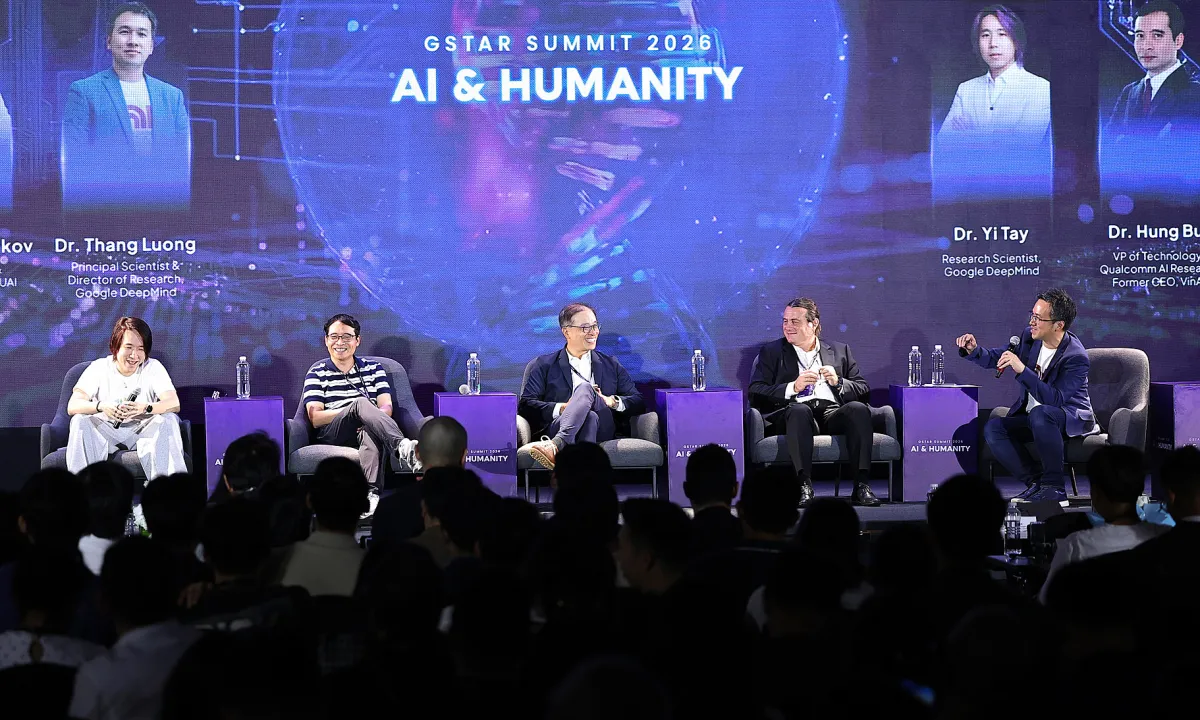 'Việt Nam không nên cố xây mô hình AI lớn'
Các chuyên gia quốc tế cho rằng AI hiện đã quá mạnh và ngày càng hoàn thiện, do đó Việt Nam nên tập trung vào phát triển con người.


