
A decade ago, Global Capability Centers (GCCs) in India were largely viewed as cost-saving extensions of global headquarters. Companies set up offshore teams primarily to reduce operational expenses while handling support functions from a distance.
That narrative has changed.
In 2026, India has become one of the world's most important destinations for product engineering, AI innovation, cloud infrastructure management, cybersecurity operations, and enterprise technology development. Global organizations are no longer building GCCs solely to optimize costs, they are establishing strategic centers that drive product roadmaps, own critical business functions, and contribute directly to growth.
The opportunity is significant, but so is the challenge.
Many companies still follow the traditional GCC setup model: incorporate a legal entity, secure office space, establish payroll systems, hire an HR team, build recruitment processes, and then begin hiring. While this approach may seem logical, it often takes six to nine months before the first meaningful team is operational.
For fast-growing businesses, that delay can be costly. Product launches get pushed back, engineering roadmaps slow down, and competitors gain an advantage.
The companies scaling successfully today are approaching GCC development differently. Rather than treating setup as a single large project, they are breaking it into phases that prioritize speed, flexibility, and risk reduction.
Phase 1: De-Risking the Setup with a Phased Framework
One of the biggest misconceptions surrounding GCC expansion is that a company must establish a legal entity before hiring its first employee in India.
In reality, many organizations are adopting a phased approach that allows them to begin building teams immediately while evaluating long-term investment plans.
The goal during the initial stage is not infrastructure. It is validation.
Companies first focus on hiring a small group of key personnel; engineering leaders, product managers, solution architects, or operational heads, who can establish local leadership and provide market insights. These early hires help define hiring strategies, technology requirements, and organizational structure before significant capital commitments are made.
An Employer of Record (EOR) framework enables businesses to onboard these critical team members within weeks rather than months. Instead of navigating incorporation requirements, labor registrations, and payroll compliance from day one, organizations can begin operations while maintaining full flexibility over future expansion decisions.
For global enterprises looking to test the waters without heavy upfront capital, leveraging a specialized partner for GCC consulting and managed compliance frameworks allows leaders to shift their focus entirely onto product delivery rather than regulatory paperwork.
This phased model has become particularly valuable for venture-backed technology companies and mid-market enterprises that need rapid market entry without introducing unnecessary operational complexity.

Phase 2: Building the Talent Engine (Hiring for Capabilities, Not Just Headcount)
Once the foundation is in place, the next challenge emerges: talent acquisition.
This is where many GCC initiatives either accelerate or stall.
Historically, organizations measured hiring success through headcount growth. The objective was simple, fill seats quickly and build teams at scale.
Today's GCC landscape requires a different mindset.
The most successful centers are built around specialized capabilities rather than volume hiring. Organizations are competing for professionals in areas such as Generative AI, MLOps, Platform Engineering, Cloud Security, DevSecOps, Data Engineering, and Enterprise Architecture.
These talent pools are highly competitive.
A strong candidate may receive multiple offers within days. Delayed interview cycles, misaligned compensation structures, or poor candidate experiences often result in offer declines, even when the employer brand is well-known globally.
Building a sustainable talent engine requires a localized recruitment strategy that reflects current market realities.
This includes:
Competitive compensation benchmarking
Faster interview and evaluation processes
Strong employer branding in local talent communities
Candidate engagement throughout the hiring journey
Clear career progression pathways
Flexible workplace policies
Organizations that rely exclusively on global hiring playbooks frequently struggle because local market dynamics differ significantly from those in North America or Europe.
Attracting premium tech talent in competitive hubs like Delhi NCR or Bengaluru requires deep local market intelligence. Working with an established agency that handles offshore team hiring and strategic talent acquisition ensures you are targeting high-intent, top-tier candidates.
The objective is not simply to hire faster. It is to hire the right specialists who can contribute immediately while supporting long-term organizational growth.
Phase 3: The Logistical Blueprint (Workspace & IT Asset Management)
While hiring often receives the majority of attention, operational logistics become increasingly important as teams grow.
A company may successfully recruit 50 engineers, but if those employees face delays receiving laptops, lack access to secure systems, or struggle with inadequate workspaces, productivity suffers almost immediately.
As GCCs scale toward 100 employees and beyond, operational complexity increases dramatically.
Consider the requirements involved:
Enterprise-grade laptop procurement
Device lifecycle management
Endpoint security implementation
Firewall and VPN configuration
Software licensing management
IT helpdesk support
Workspace provisioning
Access control and compliance monitoring
For organizations operating in regulated industries, secure infrastructure is not optional. Data privacy requirements, customer security expectations, and compliance obligations demand consistent operational standards across global locations.
At the same time, committing to a traditional long-term office lease often creates unnecessary risk during growth phases.
Many companies are instead choosing hybrid workspace models or fully managed office solutions that provide flexibility as hiring plans evolve. These arrangements allow organizations to scale capacity up or down without being locked into multi-year commercial real estate commitments.
A scaling team cannot function efficiently without fluid operational support. Entrusting your day-to-day logistics to a single vendor for workspace setup and automated IT procurement guarantees your distributed team remains secure, compliant, and operational from day one.
When operational systems are designed correctly, leadership teams can focus on innovation, product development, and business outcomes rather than administrative bottlenecks.

The 100-Day Scale Mandate
The most successful GCCs in 2026 are not necessarily the largest.
They are the fastest to become productive.
Organizations that continue following traditional setup models often spend months navigating incorporation, infrastructure, and operational challenges before realizing business value. Meanwhile, competitors are already hiring talent, shipping products, and expanding market presence.
Building a modern GCC requires a speed-to-market mindset.
By combining phased market entry, strategic talent acquisition, and managed operational support, organizations can move from concept to execution far more efficiently than ever before.
The companies winning in India's GCC ecosystem are not waiting nine months to build a foundation.
They are creating high-performing teams within weeks, scaling to 100+ employees with confidence, and transforming their GCCs into engines of innovation rather than back-office support centers.
In an environment where speed creates competitive advantage, the ability to scale quickly may be the most important capability of all.

Sophia Turner
1 posts
-
 Attorney general tells department to stop using X amid UK disinformation concerns
Exclusive: Richard Hermer’s office understood to be first in government to restrict use after recent riots
-
 Whistleblower Sarah Wynn-Williams sues Meta over attempts to ‘silence her’
Former employee files complaint accusing company of ‘coercive surveillance’ and first amendment violation
-
 US opens second federal investigation of deadly Tesla crash into Texas home
Driver told authorities he had driver-assistance technology engaged before crash that killed 76-year-old Martha Avila
-
 Elon Musk loses trillionaire status as SpaceX and Tesla stock drops
Falling shares push tech mogul back down to billionaire ranks after SpaceX IPO made him world’s first trillionaire
-
 AI helps read papyrus scroll burnt to crisp during Vesuvius eruption
Previously hidden text revealed without unrolling scroll discusses stoic philosophy on ethics, art and human behaviour
-
 Meta pauses employee tracker for AI training amid privacy concerns
About 1,600 workers signed petition against tool that tracked staff keystrokes, mouse clicks and computer screen content
-
 ‘You can’t make billions without hurting people’: Cory Doctorow on Elon Musk, the AI bubble and bosses’ cruel fantasies
The writer who coined the word ‘enshittification’ tells us why AI will never deliver what it promises – and why it still appeals so much to those in power
-
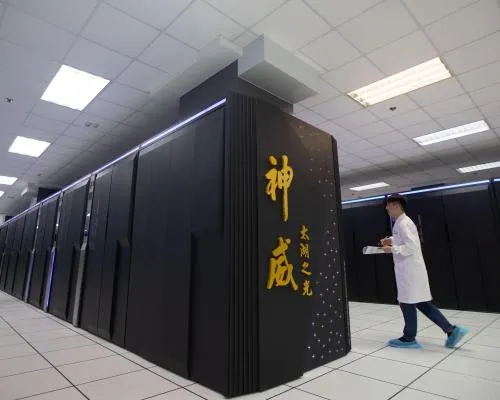 Chinese supercomputer leapfrogs best US machines to be ranked world’s fastest
China’s LineShine debuts at number one in Top500 – a list sometimes viewed as a national measure of global tech prowess
-
 Will California’s billionaire tax proposal make it to ballots?
Despite more than double the needed number of signatures to qualify for ballot, there’s uncertainty it’ll make it to voters
-
 Met to expand use of live facial recognition into central London by Christmas
Technology to be used in six more areas next year as critics say tens of thousands of people will be forced into ‘digital police lineup’
-
 HR consultant wins English court case using AI lawyer in apparent legal first
Barrister who was given material produced by Garfield AI says advocacy at trial ‘remained fundamentally human’


