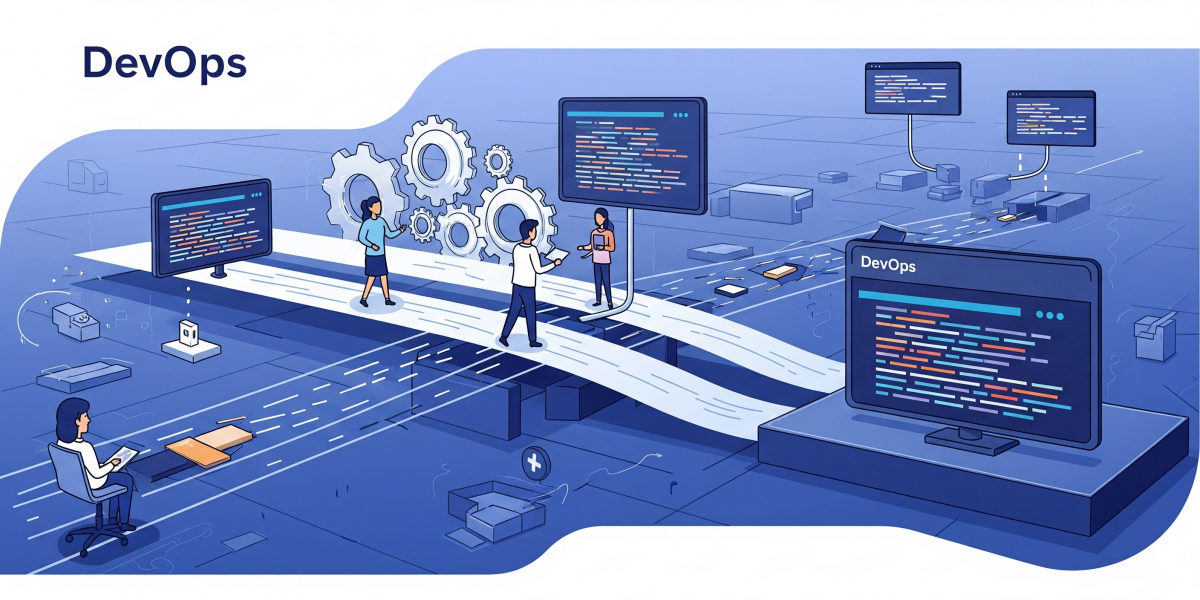
Accelerating Time to Market: Automating processes and fostering collaboration significantly reduces the time it takes to get new features and updates to users.
Improving Software Quality: Continuous testing and feedback loops lead to more stable and reliable software with fewer defects.
Enhancing Collaboration: It builds a culture of shared responsibility and transparency, leading to more efficient problem-solving.
Reducing Costs: Automation minimizes manual errors and rework, leading to cost savings in the long run.
Increasing Operational Efficiency: Streamlined workflows and proactive monitoring ensure smoother operations.
Continuous Integration (CI): Regularly merging code changes into a central repository, followed by automated builds and tests. This helps detect and address integration issues early.
Continuous Delivery (CD): Ensuring that code changes are always in a deployable state, ready to be released to production at any time. This extends CI by automating the release process.
Continuous Testing: Integrating automated testing throughout the entire software development lifecycle to ensure quality at every stage.
Infrastructure as Code (IaC): Managing and provisioning infrastructure through code rather than manual processes, ensuring consistency and repeatability.
Continuous Monitoring and Feedback: Implementing robust monitoring tools to track application performance and infrastructure health in real-time, providing immediate feedback for improvement.
Organizational Size and Complexity: Larger organizations with complex legacy systems may incur higher initial costs for cultural transformation and tool integration.
Current Infrastructure: The need for modernization or re-architecture of existing infrastructure to support DevOps practices can impact costs.
Tooling and Technology Stack: The choice of DevOps tools, licenses, and cloud services can influence expenses. Open-source tools might reduce costs, but require in-house expertise.
Talent and Training: Investing in skilled DevOps engineers or providing training to existing teams is a crucial cost factor.
Automation Scope: The extent to which automation is implemented across the software delivery pipeline directly affects the initial investment and long-term savings.
DevOps Consulting Services: Engaging a DevOps development services provider can be an initial investment but often leads to optimized implementation and faster ROI.
Faster Resolution of Issues: Quicker detection and remediation of bugs and system failures.
Reduced Complexity: Simplifies complex systems through modularity and automation.
Greater Scalability and Availability: Builds resilient systems that can handle increased load and remain operational.
More Stable Operating Environments: Achieved through consistent configurations and automated testing.
Improved Mean Time to Recovery (MTTR): Faster recovery from incidents.
Enhanced Security: Integration of security practices throughout the lifecycle (DevSecOps).
Increased Customer Satisfaction: Delivering high-quality software frequently and reliably leads to happier users.
Improved Collaboration and Communication: Breaks down silos between teams, fostering a more cohesive work environment.
Higher Employee Engagement: Teams feel more empowered and productive with streamlined processes.
Reduced Operational Costs: Automation and efficiency lead to significant savings.
Competitive Advantage: The ability to innovate and adapt quickly in the market.
Increased Revenue: Faster delivery of value-generating features.
The DevOps lifecycle is a continuous loop that encompasses several phases:
Phase
Description
Key Activities
Plan
Defining requirements, setting goals, and prioritizing tasks.
User story creation, backlog grooming, release planning
Code
Developing new features or fixing bugs.
Writing code, version control, peer reviews
Build
Compiling code, integrating changes, and creating deployable artifacts.
Automated builds, dependency management
Test
Verifying the functionality and quality of the software.
Unit tests, integration tests, performance tests, security tests
Release
Preparing the software for deployment.
Release planning, approval processes
Deploy
Pushing the software to production or staging environments.
Automated deployments, configuration management
Operate
Running and maintaining the software in the production environment.
Infrastructure management, incident response
Monitor
Collecting data on application performance and user behavior to identify issues and areas for improvement.
Logging, alerting, performance metrics, feedback collection
Export to Sheets
The DevOps development methodology is not a rigid framework but a flexible approach that leverages principles from Agile and Lean methodologies. It emphasizes:
Collaboration and Communication: Bridging the gap between development and operations.
Automation: Automating repetitive tasks across the entire lifecycle.
Continuous Feedback: Establishing fast feedback loops at every stage.
Shared Responsibility: Encouraging teams to take ownership of the entire software delivery process.
Iterative and Incremental Development: Delivering small, frequent updates rather than large, infrequent releases.
The DevOps development process follows a continuous flow, often visualized as an "Infinity Loop":
Continuous Development: Planning, coding, and version control.
Continuous Integration: Merging code, automated builds, and unit testing.
Continuous Testing: Automated functional, performance, and security testing.
Continuous Delivery/Deployment: Automated release and deployment to environments.
Continuous Monitoring: Real-time monitoring of applications and infrastructure.
Continuous Feedback: Analyzing data and feeding insights back into the development cycle.
Continuous Operations: Ensuring the smooth running of the application in production.
A robust DevOps development ecosystem relies on a variety of tools that automate and streamline processes. Here are some commonly used categories and examples:
Category
Popular Tools
Version Control
Git, GitHub, GitLab, Bitbucket
CI/CD
Jenkins, GitLab CI/CD, CircleCI, Travis CI, Azure DevOps, GitHub Actions
Containerization
Docker
Container Orchestration
Kubernetes, Docker Swarm
Configuration Management
Ansible, Chef, Puppet, SaltStack
Infrastructure as Code
Terraform, AWS CloudFormation, Azure Resource Manager
Monitoring & Logging
Prometheus, Grafana, ELK Stack (Elasticsearch, Logstash, Kibana), Splunk, Datadog
Testing Automation
Selenium, JUnit, TestNG, Cypress, Playwright
Collaboration & Project Management
Jira, Confluence, Slack, Microsoft Teams
Export to Sheets
While often used interchangeably or seen as complementary, it's important to understand the relationship between DevOps and Agile development.
Feature
Agile Development
DevOps Software Development
Focus
Iterative and incremental software development.
Automation and integration of development and operations.
Scope
Primarily development teams and practices.
Encompasses the entire software delivery pipeline, Dev + Ops.
Goal
Rapid delivery of working software, responding to change.
Faster, more reliable, and continuous software delivery.
Key Principle
Customer collaboration, responding to change.
Automation, collaboration, continuous integration/delivery.
Relationship
DevOps builds upon Agile principles, extending them to operations.
DevOps is often seen as the next logical step after Agile.
Export to Sheets
Essentially, Agile focuses on what to build and how to build it efficiently within the development team, while DevOps focuses on how to deliver and operate that software efficiently and continuously. DevOps agile development combines the best of both worlds.
Automation of the entire pipeline: From code commit to deployment and monitoring.
Early and continuous feedback: Identifying and resolving issues quickly.
Small, frequent releases: Reducing risk and accelerating innovation.
Shared tooling and platforms: Ensuring consistency and efficiency.
Metrics and data-driven decisions: Using data to improve processes and performance.
This approach is particularly impactful in DevOps application development, allowing for quicker iterations and more responsive updates.
Increased Speed and Agility: Rapid deployment of new features and fixes.
Enhanced Quality and Stability: Fewer bugs, less downtime, and more reliable systems.
Improved Team Morale and Productivity: Empowered and collaborative teams.
Better Resource Utilization: Automation reduces manual effort and frees up resources.
Stronger Security Posture: Security integrated from the start, not as an afterthought.
Scalability: Easier to scale applications and infrastructure as demand grows.
Innovation: More time for innovation due to reduced maintenance and rework.
For startups, DevOps software development isn't just an advantage; it can be a game-changer.
Faster Iteration and MVP Delivery: Startups can quickly develop and deploy Minimum Viable Products (MVPs) and iterate based on market feedback, crucial for gaining early traction.
Cost-Effectiveness: Automation reduces the need for large operations teams in the early stages, freeing up resources for core development.
Scalability from Day One: Building with DevOps principles ensures your infrastructure can scale as your user base grows without costly re-architecture.
Higher Quality Products: In a competitive startup landscape, delivering a stable and reliable product from the outset is vital for retaining users.
Reduced Risk: Frequent, small deployments minimize the impact of errors, allowing for quick recovery.
Attracting Talent: A modern, efficient development culture with DevOps development solutions is attractive to top engineering talent.
At TechQware, we offer comprehensive DevOps development services designed to optimize your software delivery pipeline, enhance collaboration, and drive business growth. Our expertise spans:
DevOps Consulting: Our experts provide DevOps development consulting to assess your current processes, identify bottlenecks, and create a tailored roadmap for your DevOps adoption.
CI/CD Pipeline Implementation: We design and implement robust continuous integration and continuous delivery pipelines to automate your build, test, and deployment processes, enabling continuous development in DevOps.
Infrastructure as Code (IaC): We help you implement IaC practices, ensuring consistent and scalable infrastructure management.
Containerization and Orchestration: Leveraging technologies like Docker and Kubernetes for efficient application deployment and management.
Automated Testing Integration: Integrating comprehensive automated testing strategies to ensure the delivery of high-quality software.
Monitoring and Logging Solutions: Setting up advanced monitoring and logging systems for real-time insights and proactive issue resolution.
Cloud Integration: Seamlessly integrating DevOps practices with leading cloud platforms (AWS, Azure, GCP).
Partnering with TechQware means gaining access to a team of dedicated DevOps specialists who understand the nuances of modern software development and operations. We empower your teams, streamline your workflows, and help you realize the full potential of DevOps Software Development.
Ready to accelerate your business with cutting-edge DevOps solutions?
Get started with TechQware today! Visit our website at https://techqware.com/ to learn more about our services and how we can help you achieve your development goals.

Tom Happy
33 posts
-
 Anthropic: Cần cơ chế dừng phát triển AI toàn cầu
Startup Anthropic cho rằng thế giới cần chuẩn bị phương án giảm tốc hoặc dừng phát triển AI nếu các mô hình có khả năng tự nâng cấp quá nhanh.
-
 Tổng Bí thư, Chủ tịch nước Tô Lâm đề nghị chuyên gia Google hỗ trợ phát triển AI
Trong buổi tiếp ông Eric Schmidt, nguyên Chủ tịch Google, cùng đoàn chuyên gia, Tổng Bí thư, Chủ tịch nước Tô Lâm đề nghị hỗ trợ Việt Nam xây dựng tầm nhìn, chính sách và hệ sinh thái AI.
-
 Máy bay chở khách có tầm bay xa nhất thế giới
Máy bay A350-1000ULR của Airbus có thể bay liên tục 22 giờ với tầm bay tối đa lên tới trên 18.000 km.
-
 Apple 'đá xoáy' trình duyệt Chrome
Trong video giới thiệu khả năng bảo mật dữ liệu riêng tư của Safari, Apple ẩn ý trình duyệt Chrome không bảo vệ người dùng trước những kẻ theo dõi.
-
 Tổng Bí thư, Chủ tịch nước Tô Lâm đề nghị Google hỗ trợ xây dựng hệ sinh thái AI
Trong buổi tiếp ông Eric Schmidt, nguyên Chủ tịch Google, cùng đoàn chuyên gia, Tổng Bí thư, Chủ tịch nước Tô Lâm đề nghị hỗ trợ Việt Nam xây dựng tầm nhìn, chính sách và hệ sinh thái AI.
-
 Truy cập Internet từ bot AI lần đầu vượt con người
Nền tảng hạ tầng Internet Cloudflare cho biết lưu lượng truy cập từ bot AI đã vượt qua con người, sớm hơn một năm so với dự đoán của công ty.
-
 Ứng dụng mô hình 4 lớp trong chuyển đổi số cấp xã, phường
Cục Chuyển đổi số quốc gia cho biết, kiến trúc gồm 4 lớp gồm hạ tầng, dữ liệu và nền tảng lõi đang được ứng dụng tại các xã, phường, giúp thúc đẩy chính quyền số, kinh tế số.
-
 iPhone 18 Pro lộ dung lượng pin
Dung lượng pin của iPhone 18 Pro được cho là chỉ nhỉnh hơn một chút so với thế hệ tiền nhiệm, nhưng thời lượng sử dụng thực tế có thể cao hơn nhiều nhờ chip mới.
-
 'Tạo ra cách làm mới bằng công nghệ số để mang lại giá trị đột phá'
Thứ trưởng Khoa học và Công nghệ Bùi Hoàng Phương khẳng định mục tiêu của chuyển đổi số là giải quyết những vấn đề thực tế bằng cách làm mới để mang lại giá trị lớn và đột phá.
-
 Mỹ loại bỏ 23 triệu kg cá chép xâm hại
Các nhà chức trách ở cơ quan động vật hoang dã đang nỗ lực loại bỏ những loài cá chép xâm hại phàm ăn như cá mè và cá trắm quanh vùng Hồ Lớn.
-
 Việt Nam đặt mục tiêu xuất khẩu công nghệ số 55 tỷ USD mỗi năm
Chính phủ đặt mục tiêu đến năm 2030 doanh thu xuất khẩu sản phẩm, dịch vụ công nghệ số đạt tối thiểu 55 tỷ USD mỗi năm, đồng thời hình thành nhiều doanh nghiệp công nghệ quy mô toàn cầu.


