By Oscar Berglund • June 22, 2026 • Sport
In today’s newsletter: How Saudi Arabia’s state-owned oil giant is embedding fossil fuels as a crucial part of the world’s biggest sport
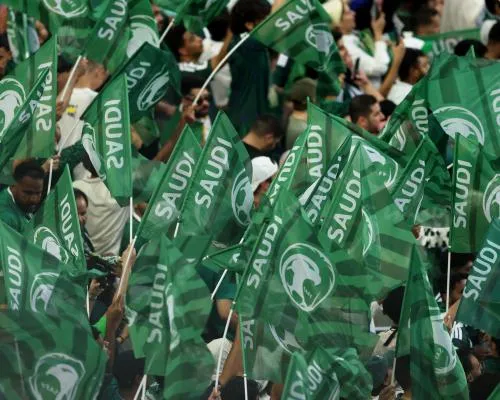
If you have watched the World Cup, you may have seen the big signs announcing Aramco as the tournament’s “energy partner”. This Saudi Arabian fossil fuel company also happens to be the world’s single largest corporate polluter while Saudi Arabia has, for decades, been the greatest stumbling block in international climate change negotiations. Aramco’s sponsorship is one aspect of Fifa’s increasing sportswashing that has angered fans around the world. This cosy relationship between modern football and the polluting industries has a long history that can be divided into three periods. First was when the game grew in British society as a tool to order and discipline workers and then became a cultural export of the British empire and capitalism. In the Factory Act of 1850, workers won the right to have Saturday afternoons free from work from 2pm, which is why the traditional kick-off is 3pm. European industrialism, militarism and colonialism further exported football across the globe and industrialisation in Britain helped create the conditions for competitions, with their need for order, discipline and structure. Football spread from England and Scotland to the industrial areas of north-east France, north-west Germany and around the ports of France, Italy, Portugal, Spain, Argentina, Uruguay and Brazil. Then came the postwar period when football was professionalised and increasingly dominated by clubs in the industrial cities. These clubs were often closely linked to the car industry, with the most evident examples being Juventus’s links with Fiat and Wolfsburg’s with Volkswagen. The economic regulations that governed football made elite men’s football a lot more spread out than it is today. At European level, after the early dominance of Real Madrid, Milan, Inter and Benfica, there was a period of “Eurosclerosis” with a decline in playing standards and the finals of the European Cup being contested between smaller clubs from smaller cities with less global appeal, such as Malmö. This relative equality was challenging to the big clubs and they started to push for changes to the competition and for more power within their leagues, especially in England, Italy and Spain. Finally, with the establishment of the Champions League and the Premier League in the early 1990s, football became increasingly globalised. This opened up the sport to new forms of fossil capital investments, often in favour of the biggest clubs in the most attractive cities. The 1990s had nine European club champions from nine cities, but only three clubs have won the Champions League who were not part of the 14 elite clubs that pushed for its expansion in the late 1990s. Those three all entered the elite level with the help of petrodollar investments: Chelsea with Roman Abramovich, Manchester City with Sheikh Mansour of the United Arab Emirates royal family and Paris Saint-Germain with Qatar Sports Investments, a subsidiary of the Qatari government. Meanwhile, for those who fail to compete, bankruptcy has become much more common. There is now only one way for a club to enter the elite level of men’s football in Europe and that is investment from a petrostate, further locking in the carbon intensity of the sport and embedding fossil fuels as a crucial part of the biggest culture in the world. Fossil capital remains strong, despite most people now understanding that fossil fuels drive climate change and are a threat to civilisation. So in order to justify delaying a green transition, fossil fuel companies need them to become a necessary evil, so embedded that we can not imagine life, let alone an enjoyable life, without them. This is where sportswashing comes into the picture and where football – and Fifa – play a very important role. For every petrostate or oil magnate that buys a football club, for every event or club sponsored by a fossil-fuel company and for every airline logo on the shirt of our favourite players, the dominance of fossil capital becomes that little bit more embedded and makes it harder to imagine the game, and the world, without it. So, as we love our beautiful game, we come to accept the necessary evil of fossil capital to keep it alive and flourishing. Aramco has bought into the World Cup in order to sell us the idea that we have no choice but to continue to burn fossil fuels. Don’t buy it. • Oscar Bergland is a senior lecturer in international public and social policy at the University of Bristol and a co-author of the report Football and climate change: A preview of the 2026 Fifa World Cup What else we’ve been enjoying Sammy Roth’s fascinating interview with Brent Suter, the baseball player tired of promoting Big Oil and the first US pro athlete to criticise fossil fuel advertising in sport. Midsummer listening with Radio 4’s Book of the Week Heatwave – the Summer of 1976 including memories of West Indies’ triumphant Test tour. Madeline Orr and Katie Gornal discuss goalies and referees under pressure on BBC World Service’s The Climate Question. More sport Two World Cup matches in the first round of games were played in severe heat, above the level previously considered safe by a players’ union, a Guardian analysis shows. Rugby World Cup winner Lewis Moody tells Don McRae about living with MND. ‘The perfect job’. Ed Aarons on the fans being paid to watch all 104 World Cup games in Times Square. More environment ‘At first the idea does seem crazy’: Damian Carrington meets the scientists trying to refreeze the Arctic. How the ‘Picasso of ponds’ went from shaping golf courses to making freshwater homes for wildlife. Patrick Barkham on the death of the most famous tree in the world. And finally … After nearly 30 years away from the public gaze in their burrow under Wimbledon common, the Wombles, the original fluffy litter-picking environmentalists, are back. Good news for Madame Cholet fans everywhere and especially for AFC Wimbledon, whose official mascot, Haydon the Womble, is often out and about at community events. Tucked in among the high-powered events at London Climate Week is a Wimbledon staff litter pick around the Cherry Red Records Stadium. At least there was – it has now been postponed due to the 38 degree heat forecast. The new Wombles have their work cut out.
Source: The Guardian

Sports Update
244 posts
-
 Heat Tobacco: Revolutionizing the Smoking Experience
Heat Tobacco: Revolutionizing the Smoking Experience
-
 Exploring Tobacco Ash: Your Ultimate Guide to Premium Smoking Accessories
Exploring Tobacco Ash: Your Ultimate Guide to Premium Smoking Accessories
-
 Your Go-To Source for All Things Cigarettes – A Comprehensive Guide
Your Go-To Source for All Things Cigarettes – A Comprehensive Guide
-
 Boy Sandals in Pakistan: A Perfect Blend of Comfort and Style
Boy Sandals in Pakistan: A Perfect Blend of Comfort and Style


