By Ewen MacAskill • June 22, 2026 • Business
American economist and long-serving head of the Federal Reserve widely praised for the US boom whose reputation was re-evaluated in the wake of the 2008 crash
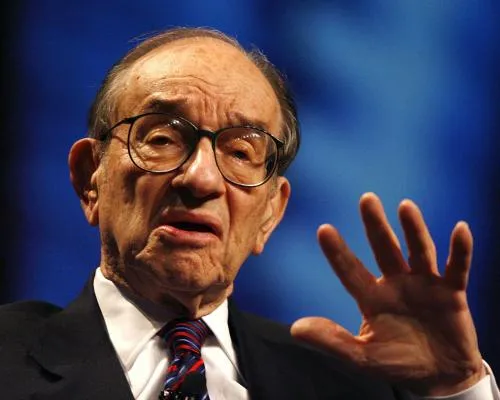
For his work chairing the US Federal Reserve, Alan Greenspan, who has died aged 100, was regularly hailed by financiers, politicians and journalists for his handling of the economy. He was variously dubbed the Oracle, the Wizard and the Maestro. As head of the central bank of the US from 1987 to 2006, tasked with setting interest rates and supervising and regulating banks and other financial institutions, he easily ranked as one of the most powerful individuals in the world. He served under four presidents: Ronald Reagan, George HW Bush, Bill Clinton – even though Greenspan was a lifelong Republican – and George W Bush. His reputation rested on a series of smart interventions that included averting a global economic meltdown after the 1987 Black Monday stock market crash and again in the 1997 Asian financial crisis, and restoring confidence in the wake of the 2001 attacks on New York and Washington. His biggest triumph was to preside over one of the longest economic booms in US history, between 1991 and 2001. “By the dawn of the new millennium, it was nearly impossible to find anyone in America who was not gaga over Greenspan. Democrats and Republicans, Wall Street and Main Street, dogs and cats – all were high on the Fed chairman,” the economic journalist Justin Martin wrote in Greenspan: The Man Behind Money (2000). Such effusive accolades were premature. Greenspan’s reputation had to be downgraded after the 2008 financial crash, the biggest shock to the global economy since the Great Depression. Although he had left office two years earlier, the elements that led to the crisis – financial deregulation, reckless bankers, derivatives, the housing boom, low interest rates and sub-prime mortgages – happened on his watch. Robert Reich, secretary of labor under Clinton, wrote in the Guardian in 2009 that when the housing bubble burst, “the entire global financial system went down with it. There’s no single culprit for the mess we’re in, but Alan Greenspan comes closest.” Two years later, a congressional commission set up to investigate the crash concluded that, while major financial institutions, along with others, had been to blame, Greenspan too had been culpable. Its report said that he, along with others, had championed, for more than 30 years, deregulation of the financial sector and reliance on self-regulation that had “stripped away key safeguards, which could have helped avoid catastrophe”. At a hearing of the House oversight committee in 2008, Greenspan acknowledged he had been “partially” wrong in his hands-off approach to the banking sector. What was stunning, though, was his admission that there was “a flaw” in the libertarian conservative ideology that had guided him throughout most of his life. “I made a mistake in presuming that the self-interests of organisations, specifically banks and others, were such that they were best capable of protecting their own shareholders and their equity in the firms,” he said. That ideology was one propagated by the Russian émigré writer Ayn Rand, whose novel Atlas Shrugged (1957) was to inspire future generations of neo-liberals. Greenspan had had little interest in politics until he met her in 1952, but became part of her inner circle, a regular for the next 15 years at weekly discussions and debates at her New York home. He described her views as “intoxicating”, while she, in an interview with the New York Times in 1974, said: “Alan is my disciple philosophically.” She opposed government intervention in the financial sector, arguing it should be left to police itself and that capitalism worked best when people acted out of rational self-interest rather than altruism. While Greenspan adhered to this in principle, expressing concern that government intervention risked unintended and negative consequences, this did not stop him intervening as head of the Fed, from tinkering with interest rates to supporting government bailouts. Such contradictions, along with the power he wielded, his relationship with Rand, his unorthodox route to the Fed – he began his adult life playing the saxophone and the clarinet in a New York swing band – and his subsequent rise and fall made him an intriguing subject for profile writers and biographers. The journalist Sebastian Mallaby, in his 2016 biography The Man Who Knew: The Life and Times of Alan Greenspan, concluded: “America’s political culture adores leaders but is merciless when they fall short … From hero to antihero, from maestro to villain, his story is a fable of the land that made him.” A New Yorker, Greenspan had been, before entering into politics and public life, a partner from 1953 in Townsend-Greenspan, a small, successful firm providing forecasts for investors and financial institutions, identifying trends such as demand for steel. He became sole head of the firm in 1958. In spite of being ideologically opposed to government intervention, he decided it was better to try to influence events from the inside rather than writing pamphlets from the outside, and worked as an adviser on Richard Nixon’s successful 1968 presidential campaign. He worked too for Nixon’s successor, Gerald Ford, as chair of the Council of Economic Advisers to the White House (1974-77) before going on to work for Reagan, who appointed him head of the Fed. Within two months of taking over, Greenspan faced what was to be one of his biggest challenges, the Black Monday crash that saw the Dow Jones index drop 22.6% in a single day. The Fed acted decisively to calm the markets in the US and elsewhere around the world by issuing a statement the following day pledging to serve as a source of liquidity to support the economy. His relationship with George HW Bush was fraught. Bush wanted cuts to stimulate the economy and Greenspan’s reluctance led Bush publicly to blame him for his defeat in the 1992 White House election. This show of independence enhanced Greenspan’s reputation. As a Republican, Greenspan was anxious about his job prospects under a Democrat in the White House. But Clinton and Greenspan established a rapport and Clinton went on to embrace both deregulation and deficit cuts. Boosted by the emergence of new technology companies, Clinton’s two terms were marked by rising stock markets, jobs growth, increased productivity and low inflation. Among interventions overseas, Greenspan, as well as his role in the aftermath of the Asian financial crash, helped organise a $50bn bailout of the Mexican peso in 1995. Throughout Greenspan’s time at the Fed, his power to move markets meant financiers and journalists scanned his every utterance hoping for an insight into rates. Conscious of this, he was often deliberately vague, given to mumbling and convoluted sentences. In 1996, in what was one of his most famous quotes, he said: “I know you think you understand what you thought I said, but I’m not sure you realise that what you heard is not what I meant.” In another remark that became famous, he set off a panic on the Tokyo stock market when, buried in a 1996 speech, he spoke of “irrational exuberance”, which was interpreted as his believing the stock market was overvalued. He came up with the phrase soaking in a bath tub: he spent 90 minutes each morning doing his work in the bath because it helped ease his chronic back pain. Greenspan described Clinton as his favourite president, along with Ford. His relationship with George W Bush was as poor as it had been with Bush Sr. They disagreed on how to respond to the bursting of the dotcom boom – the collapse of the new technology companies after rapid expansion – that led to a recession shortly after he became president in 2001. And then came the shock of the 9/11 attacks. In response, Greenspan pumped $100bn into the monetary system and cut interest rates, helping to restore confidence. After his departure from the Fed, he was invited by the British chancellor Gordon Brown to work as an unpaid adviser to the Treasury. In 2002, Greenspan had received an honorary knighthood from Queen Elizabeth II. His memoir The Age of Turbulence was published in 2007. He followed this in 2013 with The Map and the Territory: Risk, Human Nature and the Future of Forecasting, and in 2018 with Capitalism in America, co-written with the then Economist journalist Adrian Wooldridge. Unimpressed by President Donald Trump, in 2018 he described Trump’s proposed tariffs as “insane” and said that both the US and China would lose out in such a trade war. Born in New York, Alan was brought up during the Great Depression. His parents, Rose (nee Goldsmith) and Herbert Greenspan, a small-time stockbroker, divorced a few years after his birth. He and his mother, who reverted to her maiden name, moved in with her parents into a cramped home in Washington Heights, then a working-class district of predominantly Irish, German and Jewish immigrants. His mother worked as a sales assistant at a furniture store. Alan started at the George Washington high school in 1940 and left three years later to study the clarinet and saxophone at the Juilliard School for performing arts. Aged 18, he joined the Henry Jerome orchestra, which played in New York and on tour around the US. Band members recalled Greenspan as a talented musician and just as talented at doing the band’s accounts and the members’ tax returns. He spent breaks between sessions reading, and his interest in finance started with a book about the British stock exchange. He left the band after 16 months to study at New York University, where he was awarded a BA in economics in 1948 and an MA two years later. He began writing a thesis for a PhD from Columbia University but, distracted by his outside consultancy work, failed to complete it. He was eventually awarded his PhD by New York University in 1977. He married Joan Mitchell, an artist, in 1952 but the marriage was annulled a year later. In 1997, he married the television journalist Andrea Mitchell, and she survives him. • Alan Greenspan, economist, born 6 March 1926; died 22 June 2026
Source: The Guardian

Business Daily
145 posts