By Severin Carrell Scotland editor • June 17, 2026 • UK news
Minnie the Minx and Macbeth feature in National Library’s exploration of how rainfall has shaped Scottish science, literature, history and identity
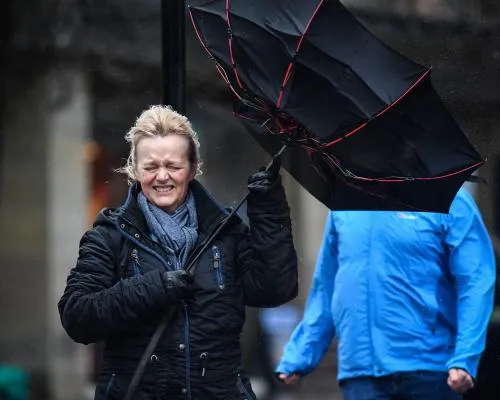
It seems fitting that, 250 years ago, one of Scotland’s foremost scientists took a close interest in what is arguably the country’s most famous feature: rain James Hutton, celebrated by Scots as the father of modern geology, went so far as to write a formula for “a theory of rain”. In 1784, he sketched out the key principles for the “condensation of aqueous vapour contained in the air”. Now, Hutton’s calculations are to take centre stage in an exhibition celebrating rain at the National Library of Scotland in Edinburgh. Between 100bn and 160bn cubic metres of rain fall on Scotland each year. The library has drawn on two of the country’s great literary heroes – Minnie the Minx and Robert Burns – pairing them with tartan samples of the rainproof Mackintosh fabric invented by the Glasgow-born chemist Charles Macintosh in 1823. Alongside copies of the Beano – including a cartoon strip featuring Minnie and the Met Office educating children about the dangers of storms – the National Library of Scotland is showing a rare original copy of Daemonologie, the treatise on witches and the supernatural by King James VI of Scotland and I of England and Wales. Written in 1597 against a backdrop of violent persecution of alleged sorcerers and witches, the text blames them for conjuring months of storms that delayed the boat carrying his new queen Anne of Denmark from arriving in Scotland. “They can raise stormes and tempests in the aire, either upon sea or land,” the king wrote. Daemonologie is credited with inspiring the witches who opened William Shakespeare’s Macbeth, which also features in the exhibition, alongside the rain that drenches Burns’s antihero Tam O’Shanter as he flees a storm and a “hellish legion” of demons. Alison Stevenson, the library’s director of collections, said the institution’s exhibitions were usually biographical or historical, but this display broke with those confines. “Rain is in our manuscripts, our maps, poetry, prose, vast newspaper collections, films – you name it. Rain is such an intrinsic part of life in Scotland. We have a relationship with rain whether we want to have one or not,” she said. “We talk about it, dress for it, measure it, write about it, avoid it, worry about it, sing about it. This exhibition covers all perspectives.” Happily for tourists dashing in to escape a summer shower, the exhibition is in a room only a few steps from the library’s front door. Inside, visitors can study early rain maps of Scotland, brought in from the library’s renowned cartographic collection, including one from 1912 charting 25 years of rain. Many may be surprised to learn that, despite the rain that drenches western and northern Scotland, Edinburgh is one of the drier cities in the UK – Rome gets more rain annually. The exhibition also includes a weather forecast wall, where visitors can play TV meteorologist on a vast chart using pre-digital detachable rain, cloud and sun symbols. Heather Reid, one of Scotland’s best-known forecasters, is opening the exhibition on 17 June. She is best known to BBC Scotland viewers as Heather the Weather. The exhibits range from the “angler poet” Thomas Tod Stoddart bemoaning the impact of a drought on the Tweed fishery in 1864 to the diarist Mary Cumming Bruce noting, with sketches, how in 1889 a rain-soaked boy stared at her for carrying an umbrella – then a fashionable symbol of wealth. Rain’s capacity for endangering lives has more recent resonance for the library. In early 2023, its preventive conservator, Mel Houston, was killed in a flash flood in the Borders. She had played “a pivotal role in making sure our buildings and collections will withstand rising temperatures and water levels caused by climate change”, the library said. The exhibition will be dedicated to her memory. Rain opens to the public on Friday 19 June and runs until 30 April 2027.
Source: The Guardian

Uk News Feed
121 posts
-
 Ex-health worker cautioned after Kate’s medical notes offered for financial gain
Information commissioner issues formal caution after London private hospital treating royal reported breach
-
 New homeowner finds skeletal remains of three people in auction-bought Connecticut home
Attorney asks court to return $82,000 deposit to buyer if 2025 foreclosure is invalidated due to discovery
-
 Thủ tướng đề nghị doanh nhân Việt tại Nga phát huy vai trò cầu nối kinh tế
Thủ tướng Lê Minh Hưng gặp kiều bào tại Kazan, kêu gọi các doanh nhân trở thành cầu nối đưa hàng Việt vào thị trường Nga và Liên minh Kinh tế Á - Âu.
-
 Iran sẽ rước linh cữu cố lãnh tụ Ali Khamenei qua Iraq
Thị trưởng Tehran cho biết linh cữu cố lãnh tụ tối cao Ali Khamenei sẽ được rước qua Iraq trước lễ chôn cất tại Iran vào đầu tháng 7.
-
 Lives and incomes lost as Ebola takes toll on Bunia’s public-facing workers
A headteacher, a motorcycle taxi driver and a travel agent are among those who are counting the human and economic cost of the virus
-
 UK critical infrastructure hit by 200 cyber incidents in a year, agency says
Head of National Cyber Security Centre says UK in ‘ongoing contest with capable adversaries’ and AI could add to threat
-
 Kash Patel accused of directing $1m to ‘slush fund’ to pay bonuses to loyalist agents
Congressman Jamie Raskin alleges FBI director authorized substantial recurring payments to agents in his inner circle
-
 ‘Very naive’: French left up in arms as Macron hosts Trump at Versailles
Political rivals accuse French president of grovelling after inviting US counterpart to Louis XIV’s palace
-
 Thủ tướng tham quan trực thăng, xe tải tại triển lãm ở Tatarstan
Thủ tướng Lê Minh Hưng tham quan các phương tiện công nghệ cao như xe tải KAMAZ, trực thăng, UAV tại triển lãm Made in Tatarstan ở Kazan.
-
 Harry and Meghan to bring children to UK for first time in four years
Prince Archie and Princess Lilibet last visited Britain in 2022 during late queen’s platinum jubilee celebrations
-
 NetJets aircraft crashes on Texas highway, killing one and injuring five
The jet, owned by Warren Buffett’s Berkshire Hathaway, lost contact with air traffic control and crashed in Laredo


